Gomphocarpus fruticosus
(L.) Aiton f.
Cotine, Firesticks, Narrow-leaved cotton bush
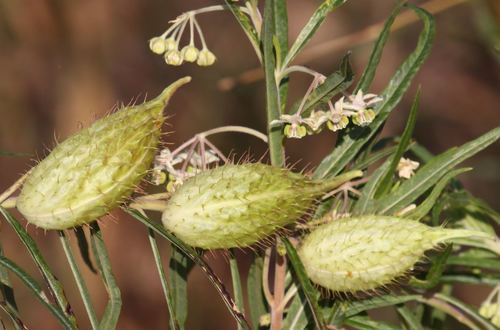
(c) lemurtaquin, some rights reserved (CC BY-NC), uploaded by lemurtaquin
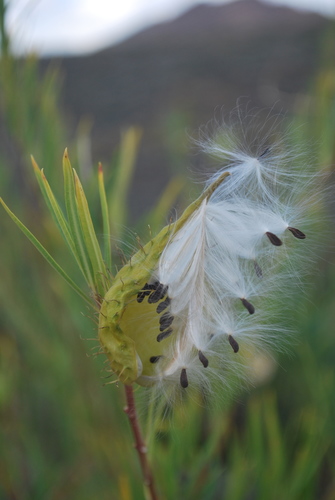
(c) ribbokspoort, some rights reserved (CC BY-NC)

(c) Dave Richardson, some rights reserved (CC BY), uploaded by Dave Richardson
What to Eat
Edible parts: Roots, Fruit, Caution, Vegetable
The rootstock is eaten as a vegetable. Some caution should be applied - see above regarding toxicity. Masai of Tanganyika eat the fruit. Some caution should be applied - see above regarding toxicity
Known Hazards
Where to Find It
It is a tropical plant. In grows in savannah grassland in Guinea. It is usually in sandy soil and often in soil that is occasionally waterlogged. It is often along the edges of rivers. In southern Africa it grows between 45-1,500 m above sea level. It can grow in arid places. In Yunnan.
Africa*, Albania, Algeria, Angola, Argentina, Asia, Australia, Botswana, Brazil, Canary Is., Caucasus, Central Africa, China, Colombia, Crete, Cyprus, Djibouti, East Africa, Eritrea, Eswatini, Ethiopia, France, Greece, Guinea, Guinée, India, Italy, Kenya, Lebanon, Lesotho, Madagascar, Malawi, Mauritius, Morocco, Mozambique, Namibia, New Zealand, North America, Oman, Reunion, Saudi Arabia, Seychelles, Somalia, South Africa, Southern Africa, Spain, Sudan, Suriname, Syria, Swaziland, Tasmania, Tanzania, Tunisia, Turkey, Türkiye, Uganda, Uruguay, USA, Uzbekistan, Venezuela, Vietnam, West Africa, Yugoslavia, Zambia, Zimbabwe,
How to Identify
A herb or small shrub. It can grow each year from seed or keep growing from year to year. It grows 2-4 m high. It has milky latex. The leaves are in pairs and are hairy. The leaf blade is 4-12 cm long by 1 cm wide. They are narrowly sword shaped. The flowers occur in groups or 4-7 in a nodding group along the stalk. They are hairy. The fruit are follicles. They are spindle shaped and 5-8 cm long by 2-3 cm wide. The seeds are dark and have cotton like hairs attached.
How to Grow
Succeeds in tropical, subtropical and warm temperate climates. Requires a well-drained soil and a position in full sun. Plants are deep-rooted and do not transplant readily. Seedling plants can flower within one year. The stems are hollow and, when cut, exude a milky latex. Plants tend to become leggy after a few years and are usually replaced every 2 - 3 years when grown as an ornamental.
Propagation: Seed - surface sow and make sure they do not dry out. Make sure the seedlings are potted on as soon as they are large enough to handle, and plant them out when about 20cm tall. Cuttings of young growth, rooted in a sandy medium. Root cuttings.
Medicinal Uses
The plant is used medicinally in many parts of Africa, whilst it is also cultivated for medicinal use in China. Some care needs to be employed, however, because of the presence of toxins. Research has shown the presence of alkaloids in all parts of the plant. The presence of cardio-active glycosides, named gofruside A and B, has been reported. A decoction of all parts of the plant is used as a treatment for stomach troubles. A decoction of the plant is taken by mouth for treating asthma and difficulty in breathing. The patient must vomit after taking the dose. Applied externally, it is used to treat sores, boils and swellings on the neck. Swellings generally are treated by massaging the area with a decoction of the plant combined with Vernonia appendiculata, whilst for lumbago the plant is dried and mixed with honey to make a paste and then applied with a massage. The plant (part unspecified) is taken in small doses for treating excess of bile; it is also used for headaches The leaves are used as a treatment for pulmonary tuberculosis. They are used as a sedative in the treatment of headache and tuberculosis. The dried leaves, flowers and young shoots are ground up and used as a snuff given to seriously ill patients. If the patient does not sneeze the case is considered hopeless! The roots are used to relieve stomach pain and general aches in the body. A latex contained in the plant is used against toothache A decoction of the seeds is used as a cough-medicine.
Other Uses
The floss from the seeds is used for stuffing pillows. It is also spun into a white cotton which is used for decoration and to make into belts. The inner bark yields a strong, white bast fibre. Fibre length is uneven though an average is about that of cotton. There is an absence of twist which may make it difficult to spin, but if it can be properly handled a soft fabric should be producible. It may be suitable for admixture with cotton. The fibre is spun into a cotton for sewing clothes and for snaring birds. In Somalia it is commonly used as string for snares and to make waistbands.
Wikipedia
Source ↗Gomphocarpus fruticosus (swan plant; narrow-leaved cotton bush) is a species of plant native to South Africa. It is also common in Australia and New Zealand where it is a host of the monarch butterfly. The plant's tissues contain sufficient cardenolides that consumption of significant quantities of the plant's leaves, stems, or fruit may lead to death in livestock and humans. The plant, also referred to as Narrow leaf cotton bush, has officially been declared a pest in Western Australia. The species is closely related to Gomphocarpus physocarpus.
Notes
Also put in the family Asclepiadaceae.
Names & Synonyms
Fanoro, Gansies, Kapokbos, Khakhayi, Lebeyana, Melkbos, Motswamaswi, Mufuramvu, Musasasa, Oruseppa, Siriri, Suduluguru, Tondel, Tontelbos, Wilde kapok
References (12)
- Baker, M. L. & de Salas, M. F., 2012, A Census of the Vascular Plants of Tasmania. (On line)
- Burkill, H. M., 1985, The useful plants of west tropical Africa, Vol. 1. Kew.
- Fowler, D. G., 2007, Zambian Plants: Their Vernacular Names and Uses. Kew. p 76
- Grubben, G. J. H. and Denton, O. A. (eds), 2004, Plant Resources of Tropical Africa 2. Vegetables. PROTA, Wageningen, Netherlands. p 562
- Guillarmod, J., 1971,
- Kew Plants of the World Online
- Mutie, F. M., et al, 2023, Important Medicinal and Food Taxa (Orders and Families) in Kenya, Based on Three Quantitative Approaches. Plants 2023, 12, 1145
- Peters, C. R., O'Brien, E. M., and Drummond, R.B., 1992, Edible Wild plants of Sub-saharan Africa. Kew. p 64
- Royal Botanic Gardens, Kew (1999). Survey of Economic Plants for Arid and Semi-Arid Lands (SEPASAL) database. Published on the Internet; http://www.rbgkew.org.uk/ceb/sepasal/internet [Accessed 30th March 2011]
- Welcome, A. K. & Van Wyk, B.-E., 2019, An inventory and analysis of the food plants of southern Africa. South African Journal of Botany 122 (2019) 136–179
- World Checklist of Useful Plant Species 2020. Royal Botanic Gardens, Kew
- www.zimbabweflora.co.zw 2011


