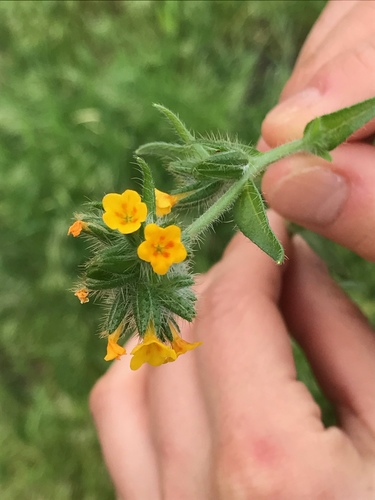
Heliotropium ovalifolium
Forssk.
Grey-leaf heliotrope

(c) Dewald du Plessis, some rights reserved (CC BY-NC)

(c) Tony Rebelo, some rights reserved (CC BY-SA)

(c) Tony Rebelo, some rights reserved (CC BY-SA)
What to Eat
Edible parts: Fruit, Leaves, Caution
Heliotropes are popular garden plants, most notably H. arborescens (garden heliotrope). Garden heliotrope is grown in Southern Europe as an ingredient for perfume. Heliotrope is the main ingredient in perfumes such as Byredo Heliotropia, Molinard Heliotrope, Etro Heliotrope, Fragonard Héliotrope Gingembre and others. The sap of heliotrope flowers, namely of H. europaeum (European heliotrope), was used as a food coloring in Middle Ages and Early Modern French cuisine.
Known Hazards
Where to Find It
It is a subtropical plant. It grows in open sunny places. It grows in hot and arid places with a marked dry season. It can grow in salty soils. It can grow in coastal sands. It grows from sea level to 1,635 m above sea level. It can tolerate shade. It can grow in arid places.
Africa, Angola, Arabia, Asia, Australia, Botswana, British Indian Ocean Terr., BIOT, Central Africa, Congo, East Africa, Egypt, Eswatini, Ethiopia, Guinea, Guinée, Guinea-Bissau, India, Indochina, Kenya, Madagascar, Malawi, Middle East, Mozambique, Myanmar, Namibia, Nigeria, North Africa, Pakistan, Saudi Arabia, SE Asia, Senegal, Somalia, South Africa, Southern Africa, Swaziland, Taiwan, Tanzania, West Africa, Zambia, Zimbabwe,
How to Identify
An annual herb. It grows 40-90 cm high. It can be erect or bend over. The stems are hairy. They are woody at the base. The leaf blades are 1-2.5 cm long by 4-13 mm wide. They are narrowly oval. They have hairs in both surfaces. The flower are at the ends of branches. They are small and white. The fruit is oval with 4 nutlets.
Names & Synonyms
Embodi, Esigirait, Okambodi, Okanasana, Orujara, Sin-let-maung-gale
References (11)
- Burkill, H. M., 1985, The useful plants of west tropical Africa, Vol. 1. Kew.
- Flora of Pakistan.
- Fowler, D. G., 2007, Zambian Plants: Their Vernacular Names and Uses. Kew. p 15
- Grivetti, L. E., 1980, Agricultural development: present and potential role of edible wild plants. Part 2: Sub-Saharan Africa, Report to the Department of State Agency for International Development. p 70
- Molla, A., Ethiopian Plant Names. http://www.ethiopic.com/aplants.htm
- Peters, C. R., O'Brien, E. M., and Drummond, R.B., 1992, Edible Wild plants of Sub-saharan Africa. Kew. p 71
- Pickering, H., & Roe, E., 2009, Wild Flowers of the Victoria Falls Area. Helen Pickering, London. p 44
- Royal Botanic Gardens, Kew (1999). Survey of Economic Plants for Arid and Semi-Arid Lands (SEPASAL) database. Published on the Internet; http://www.rbgkew.org.uk/ceb/sepasal/internet [Accessed 4th April 2011]
- Scudder, 1971,
- Topp, J. M. W., 1988, An Annotated Check List of the Flora of Diego Garcia, British Ocean Territory. Atoll Research Bulletin No. 313
- World Checklist of Useful Plant Species 2020. Royal Botanic Gardens, Kew (As Euploca ovalifolia)