Maytenus undata
(Thunb.) Blakelock
South African holly, Koko tree

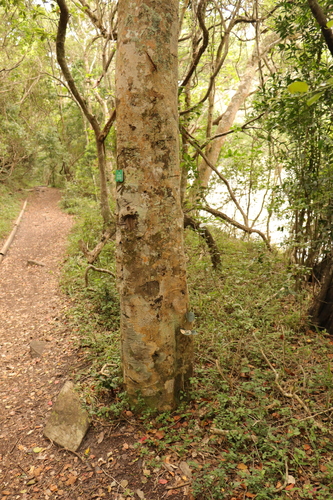
(c) Troos van der Merwe, some rights reserved (CC BY-NC), uploaded by Troos van der Merwe

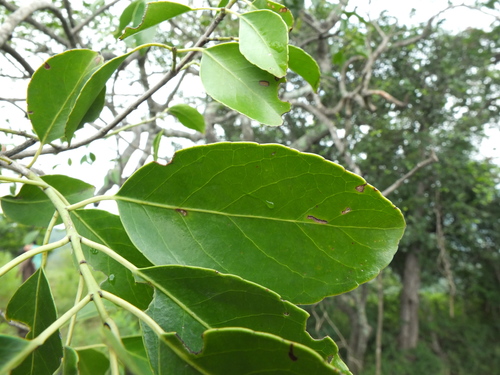
(c) Francois du Randt, some rights reserved (CC BY-NC)
What to Eat
Edible parts: Bark - flavour, Fruit, Manna, Vegetable
The bark is used for drinks and as a flavouring. The fruit are eaten raw.
Where to Find It
It is a tropical plant. It grows in lowland and mountain savannah areas in west Africa. It grows in dry soils. In Malawi it grows from 750-2,000 m altitude. It can grow in arid places.
Africa, Angola, Botswana, Burundi, Cameroon, Central Africa, Comoros, Congo, Djibouti, East Africa, Eswatini, Ethiopia, Guinea, Guinée, Kenya, Lesotho, Madagascar, Malawi, Mali, Middle East, Mozambique, Nigeria, Rwanda, Somalia, South Africa, Southern Africa, Sudan, Swaziland, Tanzania, Togo, Uganda, West Africa, Yemen, Zambia, Zimbabwe,
How to Identify
A large shrub or small tree. It grows 8 m high and the trunk is 70 cm around. It does not have spines nor hairs. The leaves are sword shaped or oval. They taper to both ends. They have blunt teeth. The leaves are 10 cm long by 4 cm wide. The flowers are in tufts. The petals are cream or green. The fruit are round and 5 mm across. They are pale yellow.
Nutrition
| Part | Moisture | kJ | kcal | Protein | Vit A | Vit C | Iron | Zinc |
|---|---|---|---|---|---|---|---|---|
| Fruit | 60.3 | — | — | — | — | 20.6 | — | — |
How to Grow
Plants are easily grown from seeds.
Names & Synonyms
Cabazinane, Cuzangandonga, Igqwabali, Izorote, Mesosoto, Morogo, Morokgwa, Mpwagili, Mutape, Sibiyabandla, Umbatacwepe, Umkokane, Umkokuza, Umugeendajoro
References (14)
- Burkill, H. M., 1985, The useful plants of west tropical Africa, Vol. 1. Kew.
- East African herbarium records, 1981,
- Grubben, G. J. H. and Denton, O. A. (eds), 2004, Plant Resources of Tropical Africa 2. Vegetables. PROTA, Wageningen, Netherlands. p 563
- Fox, F. W. & Young, M. E. N., 1982, Food from the Veld. Delta Books. p 150
- INFOODS:FAO/INFOODS Databases
- Le Houerou, H. N., (Ed.), 1980, Browse in Africa. The current state of knowledge. International Livestock Centre for Africa, Ethiopia. p 162
- Mutie, F. M., et al, 2023, Important Medicinal and Food Taxa (Orders and Families) in Kenya, Based on Three Quantitative Approaches. Plants 2023, 12, 1145
- Peters, C. R., O'Brien, E. M., and Drummond, R.B., 1992, Edible Wild plants of Sub-saharan Africa. Kew. p 80
- Royal Botanic Gardens, Kew (1999). Survey of Economic Plants for Arid and Semi-Arid Lands (SEPASAL) database. Published on the Internet; http://www.rbgkew.org.uk/ceb/sepasal/internet [Accessed 7th April 2011]
- Ruiters-Welcome, A. K., 2019, Food plants of southern Africa. Ph.D. thesis. Univ. of Johannesburg p 43
- Swaziland's Flora Database http://www.sntc.org.sz/flora
- Maurocenia frangularia
- White, F., Dowsett-Lemaire, F. and Chapman, J. D., 2001, Evergreen Forest Flora of Malawi. Kew. p 188
- World Checklist of Useful Plant Species 2020. Royal Botanic Gardens, Kew