Ipomoea bolusiana
Schinz
Narrow-leaved pink ipomoea
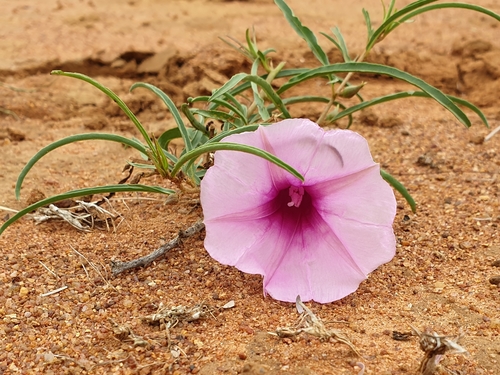
(c) Derek de la Harpe, some rights reserved (CC BY-ND), uploaded by Derek de la Harpe

(c) Richard Gill, some rights reserved (CC BY-NC)

(c) Richard Gill, some rights reserved (CC BY-NC)
What to Eat
Edible parts: Root, Tuber
The tuber and root are eaten.
Where to Find It
It is a subtropical plant. In Swaziland it is only in the low veld. It grows between sea level and 1,525 m above sea level. It grows in sandy and rocky soils. It can grow in arid places.
How to Identify
A herb. The branches are trailing. They have leaves spaced along them. These have erect flowering shoots along them. The leaf blade is divided into 3 narrow lobes up to 6 cm long by 3 cm wide. The central lobe is the longest. The flowers are erect. They are funnel shaped and 4 cm long and 4 cm wide at the mouth. The are pink or purple. It has a fattened tuber about 15 cm wide.
Medicinal Uses
Traditional uses documented across Angola, Botswana, Central Africa, East Africa, Eswatini, Madagascar, Mozambique, Namibia, South Africa, Tanzania, Zambia, and Zimbabwe.
Names & Synonyms
Etoni rombwa, Katungoloma, Otinakwi, Seakhoe
References (11)
- Fowler, D. G., 2007, Zambian Plants: Their Vernacular Names and Uses. Kew. p 21
- Guillarmod, J., 1971,
- Long, C., 2005, Swaziland's Flora - siSwati names and Uses http://www.sntc.org.sz/flora/
- Malan & Owen-Smith, 1974,
- Peters, C. R., O'Brien, E. M., and Drummond, R.B., 1992, Edible Wild plants of Sub-saharan Africa. Kew. p 94
- Roodt, V., 1998, Common Wild Flowers of the Okavango Delta. Medicinal Uses and Nutritional value. The Shell Field Guide Series: Part 2. Shell Botswana. p 63
- Royal Botanic Gardens, Kew (1999). Survey of Economic Plants for Arid and Semi-Arid Lands (SEPASAL) database. Published on the Internet; http://www.rbgkew.org.uk/ceb/sepasal/internet [Accessed 14th April 2011]
- Ruiters-Welcome, A. K., 2019, Food plants of southern Africa. Ph.D. thesis. Univ. of Johannesburg p 46
- Swaziland's Flora Database http://www.sntc.org.sz/flora
- Welcome, A. K. & Van Wyk, B.-E., 2019, An inventory and analysis of the food plants of southern Africa. South African Journal of Botany 122 (2019) 136–179
- World Checklist of Useful Plant Species 2020. Royal Botanic Gardens, Kew


