Ipomoea sinensis
(Desr.) Choisy
Purple-throat Ipomoea

no rights reserved
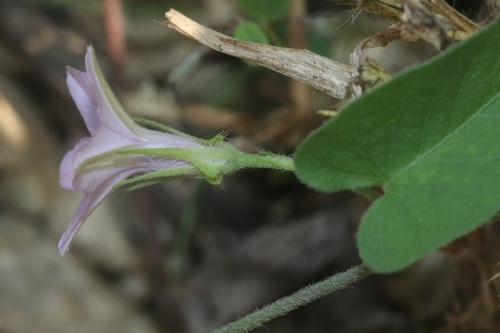
(c) James Bailey, some rights reserved (CC BY-NC), uploaded by James Bailey

no rights reserved
What to Eat
Edible parts: Leaves, Root
The root is cooked as a vegetable. The leaves are cooked as a vegetable.
Where to Find It
It is a tropical plant. In Africa it grows between 450-900 m above sea level. It grows in grassland and sandy soils.
Africa, Angola, Asia, Botswana, Burundi, Central Africa, China, Congo, East Africa, Egypt, Ethiopia, Kenya, Malawi, Middle East, Mozambique, Namibia, Niger, North Africa, Rwanda, Sahel, Somalia, South Africa, Southern Africa, Sudan, Taiwan, Tanzania, Uganda, West Africa, Yemen, Zambia, Zimbabwe,
How to Identify
A slender trailing or twining annual herb. It grows 1 m long. The leaves are oval and 2-10 cm long by 2-7 cm wide. They are heart shaped at the base. There are 1-3 flowers in a group. The fruit capsule is round and 5-10 mm across. The seeds are hairy.
Names & Synonyms
Horbaia, Hossohorbaia, Kamiwi
References (10)
- Addis, G., Asfaw, Z & Woldu, Z., 2013, Ethnobotany of Wild and Semi-wild Edible Plants of Konso Ethnic Community, South Ethiopia. Ethnobotany Research and Applications. 11:121-141
- East African Herbarium records, 1981,
- Flora Somalia Vol. 1, 1993, http://plants.jstor.org
- Goode, P., 1989, Edible Plants of Uganda. FAO p 30
- Lulekal, E., et al, 2011, Wild edible plants in Ethiopia: a review on their potential to combat food insecurity. Afrika Focus - Vol. 24, No 2. pp 71-121
- Ogle & Grivetti, 1985,
- Peters, C. R., O'Brien, E. M., and Drummond, R.B., 1992, Edible Wild plants of Sub-saharan Africa. Kew. p 95
- Roodt, V., 1998, Common Wild Flowers of the Okavango Delta. Medicinal Uses and Nutritional value. The Shell Field Guide Series: Part 2. Shell Botswana. p 64
- Ruiters-Welcome, A. K., 2019, Food plants of southern Africa. Ph.D. thesis. Univ. of Johannesburg p 46
- Welcome, A. K. & Van Wyk, B.-E., 2019, An inventory and analysis of the food plants of southern Africa. South African Journal of Botany 122 (2019) 136–179


