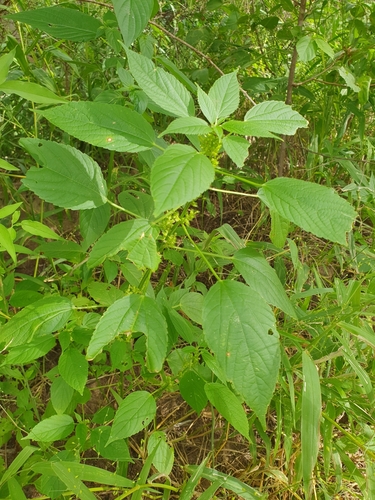
Cephalocroton cordofanus
Hochst.

GBIF
What to Eat
Edible parts: Seeds, Seeds - oil
Seed. The ovoid to nearly globose seeds are around 7.5mm long and 6mm in diameter; they are smooth, evenly greyish or dark brown flecked and mottled, somewhat shiny. The seeds are rich in a highly unsaturated oil with a pleasant odour and taste. It is sometimes extracted and used for cooking. The oil consists chiefly of cis-12:13-epoxyoleic acid (62%) along with saturated acids (7%), oleic acid (10%), linoleic acid (17%) and 12:13-dihydroxyoleic acid (4%).
Where to Find It
It is a tropical plant. It grows in dried out river beds that are seasonally flooded. It is usually on sandy soils. It grows up to 1,200 m above sea level.
Africa, East Africa, Eritrea, Ethiopia, Kenya, Nigeria, Somalia, Sudan, Tanzania, West Africa,
How to Identify
A shrub. It can be erect or sprawling and has many branches. It grows 30-300 cm tall. It has a stout taproot. The seeds are 8 mm long and 6 mm wide. They are smooth and grey. They are shiny and can be mottled.
How to Grow
Plants are grown from seeds.
Other Uses
The seeds are rich in a highly unsaturated oil. The oil consists chiefly of cis-12:13-epoxyoleic acid (62%) along with saturated acids (7%), oleic acid (10%), linoleic acid (17%) and 12:13-dihydroxyoleic acid (4%). The presence of epoxy and hydroxy fatty acids in high concentrations make the oil an interesting raw material in chemistry.
Other Information
Plants are sometimes cultivated.
References (5)
- East African Herbarium records, 1981,
- Fern, K., 2012, Tropical Species Database http://theferns.info/tropical/
- GRIN
- Peters, C. R., O'Brien, E. M., and Drummond, R.B., 1992, Edible Wild plants of Sub-saharan Africa. Kew. p 109
- World Checklist of Useful Plant Species 2020. Royal Botanic Gardens, Kew