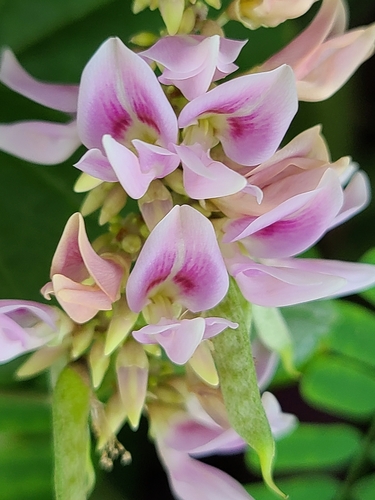
Dialium holtzii
Harms
Mpepeta

Renee Comet (photographer) AV Number: AV-9400-4164 (via Wikimedia Commons)

Royal Botanic Gardens, Kew
What to Eat
Edible parts: Fruit
The red pulp of the fruit is used for porridge, eaten like chewing gum, or made into a drink by peeling and soaking ripe fruit in warm water, then squeezing, adding sugar, and filtering. The seeds are discarded.
Where to Find It
It is a tropical plant. It grows along rivers and in dry lowland forests. In Tanzania it grows from sea level to 500 m above sea level.
Africa, East Africa, Kenya, Mozambique, Tanzania,
How to Identify
A tree. It grows 20 m tall. The crown has a medium spread. The trunk is straight and it has small buttresses. The bark is grey-brown and smooth. The leaves are compound with an odd number of leaflets. There are 11-15 leaflets. The leaf blade is 3-7 cm long by 2-3 cm wide. The flowers are cream. The fruit are dark brown. They have a brittle outer coat. The pulp is red. There are 1 or 2 round brown seeds.
How to Grow
Plants can be grown from seeds.
Other Uses
The wood is brown with darker streaks. It is very hard and heavy. It is used for poles in construction, tool handles, dhow ribs and grain mortars. The wood is used for fuel and is made into charcoal.
Wikipedia
Source ↗Dialium holtzii is a species of plant in the family Fabaceae. It is found in Kenya, Mozambique, and Tanzania.
Production
Dried fruit can be kept for over 2 years. Fruit are collected from June to September in Tanzania.
Notes
Also as Caesalpinaceae.
Names & Synonyms
M'babede, Mhetele, M'pepete, Mshila, Pepete
References (6)
- East African Herbarium records, 1981,
- Lovett, J. C. et al, Field Guide to the Moist Forest Trees of Tanzania. p 77
- Maundu, P. et al, 1999, Traditional Food Plants of Kenya. National Museum of Kenya. 288p
- Mutie, F. M., et al, 2023, Important Medicinal and Food Taxa (Orders and Families) in Kenya, Based on Three Quantitative Approaches. Plants 2023, 12, 1145
- Peters, C. R., O'Brien, E. M., and Drummond, R.B., 1992, Edible Wild plants of Sub-saharan Africa. Kew. p 122
- Ruffo, C. K., Birnie, A. & Tengnas, B., 2002, Edible Wild Plants of Tanzania. RELMA p 264