Baphia massaiensis
Taubert
Sand camwood, Jasmine pea

(c) Robert Taylor, some rights reserved (CC BY), uploaded by Robert Taylor

(c) Mark Hyde, Bart Wursten and Petra Ballings, some rights reserved (CC BY-NC)
(c) Craig Peter, some rights reserved (CC BY-NC), uploaded by Craig Peter
What to Eat
Edible parts: Fruit, Roots - tea
The seed can be roasted, then ground to a powder and used to make a coffee according to some reports, whilst other reports deny this use.
Where to Find It
It is a tropical plant. It is in open woodlands. It grows in hot arid places with a marked dry season. The dry season can be 6-11 months. It grows between 250-1,350 m above sea level. It cannot tolerate frost. It can grow in arid places. In Brisbane Botanical Gardens.
Africa, Angola, Australia, Botswana, Central Africa, Congo, East Africa, Malawi, Mozambique, Namibia, South Africa, Southern Africa, Tanzania, Zambia, Zimbabwe,
How to Identify
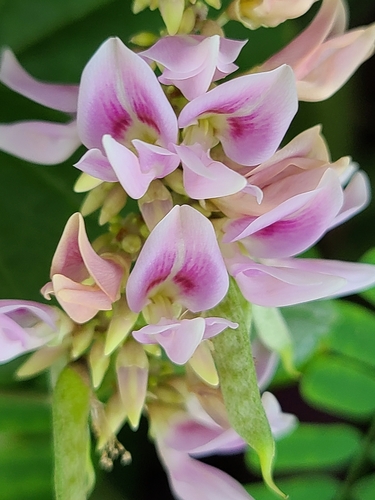
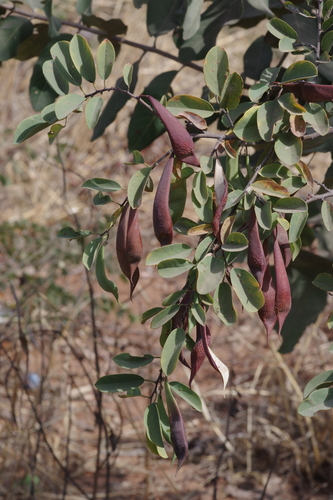
A shrub or small tree. It grows 8 m high. The leaves have leaflets 9 cm long by 5.5 cm wide. They are oval. The flowers are in groups of up to 7. These become reduced to a single flower. The petals are white with a yellow mark on the standard. The fruit is a pod 7-11 cm long by 1-1.5 cm wide. It is a purple brown. The seeds are 8-11 mm long by 7-9 mm wide. They are reddish-black.
How to Grow
Requires a sunny position. This species has a symbiotic relationship with certain soil bacteria; these bacteria form nodules on the roots and fix atmospheric nitrogen. Some of this nitrogen is utilized by the growing plant but some can also be used by other plants growing nearby.
Medicinal Uses
Root tea is traditionally prepared and consumed.
Other Uses
The branches are used as toothbrushes for cleaning the teeth. A piece of branch approximately the length and thickness of an adult male finger is used, the end is frayed for use as the brush.
Names & Synonyms
Cimpakwe, Isunde, Mbundje, M'hikinike, Mumwena, Mwama, Omulyambambi
References (13)
- Baidu-Forson, J.J., et al ,2014,. Assessment of agrobiodiversity resources in the Borotse flood plain, Zambia. CGIAR Research Program on Aquatic Agricultural Systems. Penang, Malaysia. Working Paper: AAS-2014-12.
- Flora Zambesiaca. http://apps.kew.org/efloras
- Fowler, D. G., 2007, Zambian Plants: Their Vernacular Names and Uses. Kew. p 36 (subsp. obovata)
- Grivetti, L. E., 1980, Agricultural development: present and potential role of edible wild plants. Part 2: Sub-Saharan Africa, Report to the Department of State Agency for International Development. p 71
- Mannheimer, C. A. & Curtis. B.A. (eds), 2009, Le Roux and Muller's Field Guide to the Trees and Shrubs of Namibia. Windhoek: Macmillan Education Namibia. p 160
- Peters, C. R., O'Brien, E. M., and Drummond, R.B., 1992, Edible Wild plants of Sub-saharan Africa. Kew. p 131
- Pickering, H., & Roe, E., 2009, Wild Flowers of the Victoria Falls Area. Helen Pickering, London. p 70
- Roodt, V., 1998, Trees & Shrubs of the Okavango Delta. Medicinal Uses and Nutritional value. The Shell Field Guide Series: Part 1. Shell Botswana. p 195
- Royal Botanic Gardens, Kew (1999). Survey of Economic Plants for Arid and Semi-Arid Lands (SEPASAL) database. Published on the Internet; http://www.rbgkew.org.uk/ceb/sepasal/internet [Accessed 28th April 2011]
- Ruiters-Welcome, A. K., 2019, Food plants of southern Africa. Ph.D. thesis. Univ. of Johannesburg p 56
- Scudder, 1971,
- van Wyk, Ben-Erik, 2019, The diversity and multiple uses of southern African legumes. Australian Systematic Botany, 2019, 32, 519–546
- Welcome, A. K. & Van Wyk, B.-E., 2019, An inventory and analysis of the food plants of southern Africa. South African Journal of Botany 122 (2019) 136–179