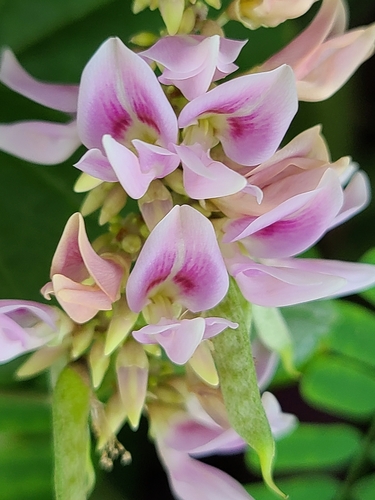
Crotalaria polysperma
Kotschy ex Schweinf.

gbif · cc-by-sa
Susan Brown
Susan Brown

gbif · cc-by-sa
Susan Brown
Susan Brown

gbif · cc-by-sa
Susan Brown
Susan Brown
What to Eat
Edible parts: Leaves, Flowers
The leaves and flowers are edible.
Where to Find It
It is a tropical plant. It can grow up to 1,050 m above sea level. It grows in grassland. It is common along the Zambezi River valley.
Africa, East Africa, Ethiopia, Kenya, Malawi, Mozambique, Sudan, Tanzania, Uganda, Zambia, Zimbabwe,
Countries: Angola, Burkina Faso, Burundi, Benin, Botswana, Congo (DRC), Central African Republic, Congo (Republic), Cote d'Ivoire, Cameroon, Cape Verde, Djibouti, Algeria, Egypt, Eritrea, Ethiopia, Gabon, Ghana, Gambia, Guinea, Equatorial Guinea, Guinea-Bissau, Kenya, Comoros, Liberia, Lesotho, Libya, Morocco, Madagascar, Mali, Mauritania, Mauritius, Malawi, Mozambique, Namibia, Niger, Nigeria, Rwanda, Seychelles, Sudan, Sierra Leone, Senegal, Somalia, South Sudan, Sao Tome & Principe, Eswatini, Chad, Togo, Tunisia, Tanzania, Uganda, South Africa, Zambia, Zimbabwe
How to Identify
An annual herb or shrub. It can grow to 1.2 m high. It is erect with many branches. These are covered with hairs. The leaves are compound with 3 leaflets. The leaflets are 3-7 cm long by 2-4 cm wide. They are narrowly oval and pointed. The flowers are in loose groups or 12-20 flowers. The flowers are blue. The fruit is a pod 4-5 cm long. The seeds are 3.5 mm long.
Names & Synonyms
Caginde, Majaghwa, Tekera
Crotalaria grantii BakerCrotalaria macrocarpa PenzigCrotalaria stewartii BakerCrotalaria winkleri Baker f.
References (7)
- Addis, G., et al, 2013, The Role of Wild and Semi-wild Edible Plants in Household Food Sovereignty in Hamer and Konso Communities, South Ethiopia. Ethnobotany Research & Applications. 11:251-271
- East African Herbarium records, 1981,
- Johns, T., Mhoro, E. B. and Sanaya, P., 1996, Food Plants and Masticants of the Batemi of Ngorongoro District, Tanzania. Economic Botany, Vol. 50, No. 1, pp. 115-121
- Lulekal, E., et al, 2011, Wild edible plants in Ethiopia: a review on their potential to combat food insecurity. Afrika Focus - Vol. 24, No 2. pp 71-121
- Mutie, F. M., et al, 2023, Important Medicinal and Food Taxa (Orders and Families) in Kenya, Based on Three Quantitative Approaches. Plants 2023, 12, 1145
- Peters, C. R., O'Brien, E. M., and Drummond, R.B., 1992, Edible Wild plants of Sub-saharan Africa. Kew. p 132
- Reis, S. V. and Lipp, F. L., 1982, New Plant Sources for Drugs and Foods from the New York Botanical Garden herbarium. Harvard. p 131