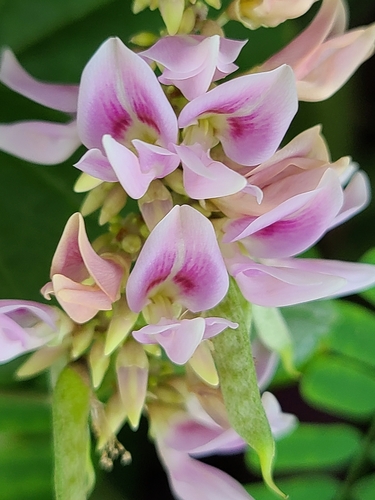
Crotalaria recta
Steud. ex A. Rich.

(c) Delia Oosthuizen, some rights reserved (CC BY-NC), uploaded by Delia Oosthuizen
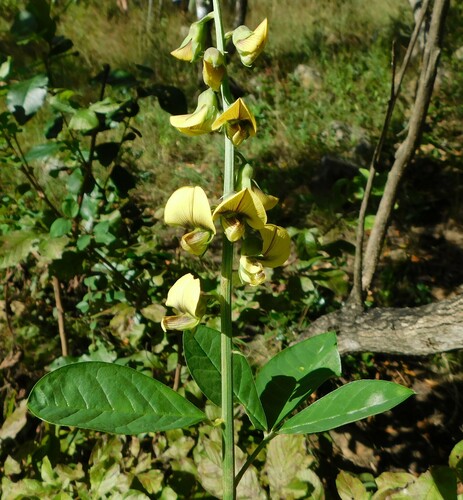
(c) qgrobler, some rights reserved (CC BY-NC)
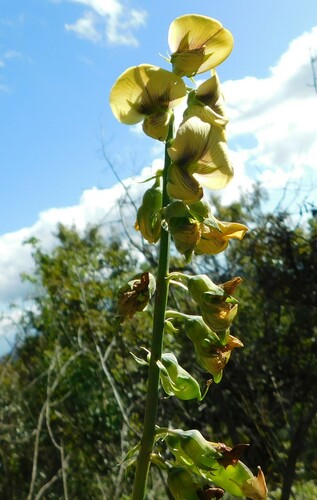
(c) qgrobler, some rights reserved (CC BY-NC)
What to Eat
Edible parts: Flowers
The flowers are edible.
Known Hazards
Where to Find It
In Swaziland it is in the high veld only.
Africa, Angola, Central Africa, East Africa, Eswatini, Ethiopia, Malawi, Mozambique, Nigeria, South Africa, Southern Africa, Swaziland, West Africa, Zambia, Zimbabwe,
How to Identify
A tall herb or shrub. It grows 1.8 m high. It is stiffly erect with few branches. It has some fine hairs. The stem has some ribs. The leaf stalk is 4 cm long. The leaflets are broadly oval. They are 9 cm long by 5 cm wide. They have a blunt tip with a small point. There are many large flowers. They are in 45 cm long groups at the ends of branches. They are yellow. The fruit is a pod 5 cm long by 1.5 cm wide. It becomes more broad towards the end.
Notes
It is easily damaged by Fusarium wilt.
Names & Synonyms
Ciwere
References (4)
- East African Herbarium records, 1981,
- Fowler, D. G., 2007, Zambian Plants: Their Vernacular Names and Uses. Kew. p 36
- Peters, C. R., O'Brien, E. M., and Drummond, R.B., 1992, Edible Wild plants of Sub-saharan Africa. Kew. p 132
- Swaziland's Flora Database http://www.sntc.org.sz/flora