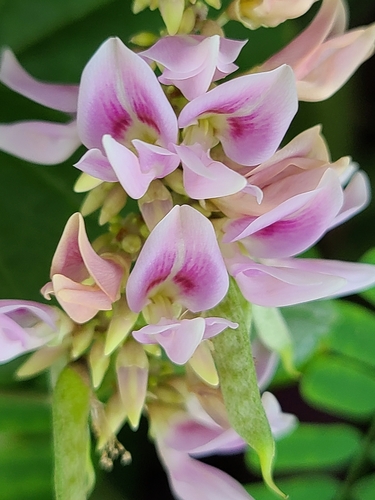
Rhynchosia hirta
(Andrews) Meikle & Verdc.

(c) Troos van der Merwe, some rights reserved (CC BY-NC), uploaded by Troos van der Merwe

(c) Troos van der Merwe, some rights reserved (CC BY-NC)
What to Eat
Edible parts: Root
The roots are used to sweeten porrigde. (As Rhynchosia albiflora) The plant (part not specified) is used as food by tribal peoples in southern India.
Where to Find It
It is a tropical plant. It grows on the edges of forests and among rocks. In Malawi it grows between 1,300-2.200 m altitude. It can grow in arid places.
Africa*, Asia, Burkina Faso, Burundi, Cameroon, Central Africa, Congo, Côte d'Ivoire, East Africa, French Guiana, Guiana, India, Ivory Coast, Jamaica, Kenya, Malawi, Mauritius, Mozambique, Nigeria, Reunion, Rwanda, South Africa, Southern Africa, Sri Lanka, Sudan, Tanzania, Togo, West Africa, West Indies, Zambia, Zimbabwe,
How to Identify
A robust creeper. It grows 5 m high. The main stems can be 8 mm across. The stems have dense rusty hairs. The leaves have 3 leaflets. These are often pale underneath. The end leaflet is 5-18 cm long by 4-14 cm wide. The side leaflets are 4-13 cm long by 3-9 cm wide. They taper to the tips. The flowering stalks can be branched and they have velvety rusty hairs. The flowers are yellow. The fruit are twisted pods 2-3 cm long by 4-7 mm wide. They are narrowly oblong. They have velvety hairs. The seeds are blue.
How to Grow
This species has a symbiotic relationship with certain soil bacteria; these bacteria form nodules on the roots and fix atmospheric nitrogen. Some of this nitrogen is utilized by the growing plant but some can also be used by other plants growing nearby.
Propagation: Like many species within the family Fabaceae, once they have ripened and dried the seeds of this species may benefit from scarification before sowing in order to speed up and improve germination. This can usually be done by pouring a small amount of nearly boiling water on the seeds (being careful not to cook them!) and then soaking them for 12 - 24 hours in warm water. By this time they should have imbibed moisture and swollen - if they have not, then carefully make a nick in the seedcoat (being careful not to damage the embryo) and soak for a further 12 hours before sowing.
Medicinal Uses
The plant (probably the leaves, but not specified induces contractions of the uterus and can be used to aid the birth process for women in labour - it can also be used to bring about an abortion.
Other Uses
(stem) Products: fibre. (seed-pod) musical instruments, games, toys, etc. A fibre usable as twine can be obtained from the li. We have seen no specific entry for this species, but all members of this genus have at least some merit for use as a ground cover and in local soil conservation projects.
Other Information
A famine food.
Names & Synonyms
Inganigani, Namalopa
References (5)
- East African Herbarium records, 1981,
- Fowler, D. G., 2007, Zambian Plants: Their Vernacular Names and Uses. Kew. p 40
- Peters, C. R., O'Brien, E. M., and Drummond, R.B., 1992, Edible Wild plants of Sub-saharan Africa. Kew. p 137
- Royal Botanic Gardens, Kew (1999). Survey of Economic Plants for Arid and Semi-Arid Lands (SEPASAL) database. Published on the Internet; http://www.rbgkew.org.uk/ceb/sepasal/internet [Accessed 29th April 2011]
- White, F., Dowsett-Lemaire, F. and Chapman, J. D., 2001, Evergreen Forest Flora of Malawi. Kew. p 334