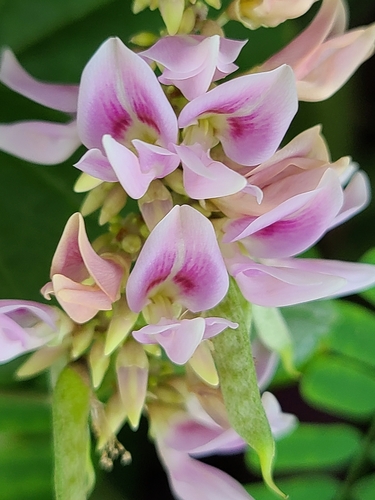
Vatovaea pseudolablab
(Harms) J. B. Gillett
Kullayya

(c) Jean-François Olivier, some rights reserved (CC BY-NC), uploaded by Jean-François Olivier

(c) Jean-François Olivier, some rights reserved (CC BY-NC)
What to Eat
Edible parts: Seeds, Pod, Leaves, Vegetable, Flowers, Tuber, Root
All parts are eaten raw or cooked. The tubers can be eaten raw, boiled, or peeled, chopped, dried and ground into flour for use with sorghum flour in porridge. Seeds can be eaten raw or cooked. Flowers and leaves are cooked and eaten.
Where to Find It
It is a tropical plant. In East Africa it often grows along dry watercourses and in dry bush land. It grows in the lowlands and midlands between 450-1,400 m altitude. It can grow in arid places.
Africa, Arabia, East Africa, Ethiopia, Kenya, Middle East, Oman, Somalia, Sudan, Tanzania, Uganda, Yemen,
How to Identify
A climbing herb. It climbs over shrubs in dry country. The stems are a greenish-purple. The roots are long and swollen. They are juicy and fibrous. The leaves have 3 leaflets. The flowers are purple and green. The fruit are pods that are slightly curved and softly hairy. They have about 6 seeds.
Nutrition Score: 34/100
| Part | Moisture | kJ | kcal | Protein | Vit A | Vit C | Iron | Zinc |
|---|---|---|---|---|---|---|---|---|
| Leaves | 83.4 | — | — | 5.4 | — | 113.7 | — | — |
How to Grow
Plants are grown from seed.
Other Uses
The root fibres are made into rope, hats and fly whisks.
Notes
There is only one Vatovaea species.
Names & Synonyms
Gaabbe, Gabe, Gele, Kela, Kelewo, Kilukyo, Kulia kurappo, Kullayya, Njiasi, Olkalai, Orkalei
References (19)
- Addis, G., Asfaw, Z & Woldu, Z., 2013, Ethnobotany of Wild and Semi-wild Edible Plants of Konso Ethnic Community, South Ethiopia. Ethnobotany Research and Applications. 11:121-141
- Brink, M., 2006. Vatovaea pseudolablab (Harms) J.B.Gillett. [Internet] Record from Protabase. Brink, M. & Belay, G. (Editors). PROTA (Plant Resources of Tropical Africa), Wageningen, Netherlands. < http://database.prota.org/search.htm>. Accessed 23 October 2009
- East African Herbarium records, 1981,
- Ethiopia: Famine Food Field Guide. http://www.africa.upenn.edu/faminefood/category3.htm
- Ichikawa, M., 1980, The Utilization of Wild Food Plants by the Suiei Dorobo in Northern Kenya. J. Anthrop. Soc. Nippon. 88(1): 25-48
- ILDIS Legumes of the World http:www:ildis.org/Legume/Web
- Kew Plants of the World On line
- Kuhnlein, H. V., et al, 2009, Indigenous Peoples' food systems. FAO Rome p 239
- Lulekal, E., et al, 2011, Wild edible plants in Ethiopia: a review on their potential to combat food insecurity. Afrika Focus - Vol. 24, No 2. pp 71-121
- Maundu, P. et al, 1999, Traditional Food Plants of Kenya. National Museum of Kenya. 288p
- Miller, A. G., Morris, M. & Stuart-Smith, S., 1988, Plants of Dhofar. The Southern Region of Oman, Traditional, Economic and Medicinal Uses. Sultanate of Oman. p 162
- Morgan, W. T. W., 1981, Ethnobotany of the Turkana: Use of plants by a Pastoral People and Their Livestock in Kenya. Economic Botany 35(1):96-130
- Mutie, F. G., 2020, Conservation of Wild Food Plants and Their Potential for Combatting Food Insecurity in Kenya as Exemplified by the Drylands of Kitui County. Plants 2020, 9, 1017
- Mutie, F. M., et al, 2023, Important Medicinal and Food Taxa (Orders and Families) in Kenya, Based on Three Quantitative Approaches. Plants 2023, 12, 1145
- Ocho, D. L., et al, 2012, Assessing the levels of food shortage using the traffic light metaphor by analyzing the gathering and consumption of wild food plants, crop parts and crop residues in Konso, Ethiopia. Journal of Ethnobiology and Ethnomedicine 8:30
- Peters, C. R., O'Brien, E. M., and Drummond, R.B., 1992, Edible Wild plants of Sub-saharan Africa. Kew. p 138
- Royal Botanic Gardens, Kew (1999). Survey of Economic Plants for Arid and Semi-Arid Lands (SEPASAL) database. Published on the Internet; http://www.rbgkew.org.uk/ceb/sepasal/internet [Accessed 29th April 2011]
- Termote, C., et al, 2014, Assessing the potential of wild foods to reduce the cost of a nutritionally adequate diet: An example from eastern Baringo District, Kenya. Food and Nutrition Bulletin, vol. 35, no. 4
- World Checklist of Useful Plant Species 2020. Royal Botanic Gardens, Kew