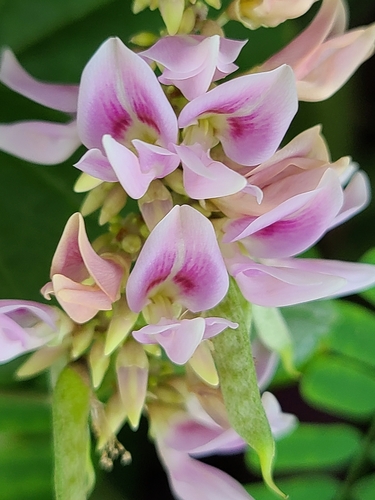
Vigna oblongifolia
A. Rich.

(c) i_c_riddell, some rights reserved (CC BY), uploaded by i_c_riddell

(c) i_c_riddell, some rights reserved (CC BY)
What to Eat
Edible parts: Roots, Tubers
Root tubers of Vigna species have traditionally been used as food by the Indigenous Peoples of the Northern Territory of Australia.
Where to Find It
It is a tropical plant. It grows in hot arid places with a marked dry season. The dry season can be 6-11 months. It can be in dry sandy soil. It grows between 335-1,300 m above sea level. It often grows along the edges of swamps. It can grow in arid places.
Africa, Angola, Botswana, Burundi, Cameroon, Central Africa, Congo, East Africa, Ethiopia, Kenya, Madagascar, Malawi, Mozambique, Namibia, Nigeria, Rwanda, South Africa, Southern Africa, Sudan, Tanzania, Uganda, West Africa, Zambia, Zimbabwe,
How to Identify
A herb. It lies along the ground or can be a climber. It can grow 4 m high. The flowers are yellow and have long stalks. There are 2 varieties.
Names & Synonyms
Umuraandaraanda
References (7)
- http://aflora.africa.kyoto-u.ac.jp
- Peters, C. R., O'Brien, E. M., and Drummond, R.B., 1992, Edible Wild plants of Sub-saharan Africa. Kew. p 139
- Royal Botanic Gardens, Kew (1999). Survey of Economic Plants for Arid and Semi-Arid Lands (SEPASAL) database. Published on the Internet; http://www.rbgkew.org.uk/ceb/sepasal/internet [Accessed 1st May 2011]
- Ruiters-Welcome, A. K., 2019, Food plants of southern Africa. Ph.D. thesis. Univ. of Johannesburg p 63
- Tanaka, 1980,
- van Wyk, Ben-Erik, 2019, The diversity and multiple uses of southern African legumes. Australian Systematic Botany, 2019, 32, 519–546
- World Checklist of Useful Plant Species 2020. Royal Botanic Gardens, Kew