Rubus ludwigii
Eckl. & Zeyh.
Silver bramble

no rights reserved, uploaded by Peter Warren
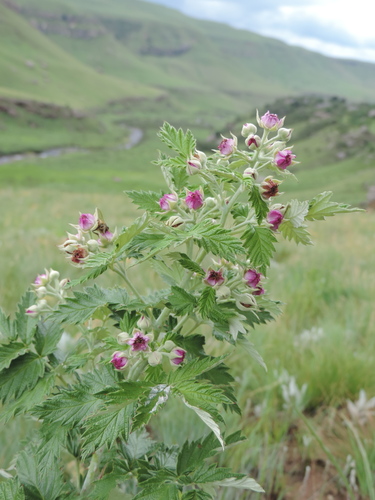
(c) Marco Schmidt, some rights reserved (CC BY-NC-SA), uploaded by Marco Schmidt
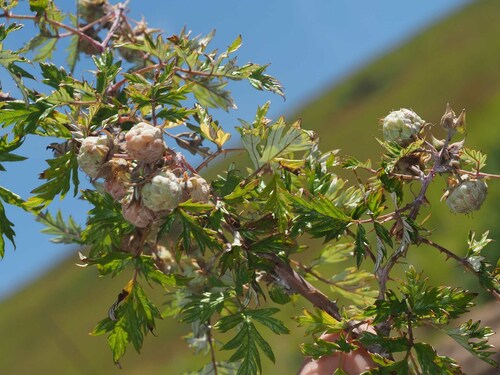
(c) Felix Riegel, some rights reserved (CC BY-NC), uploaded by Felix Riegel
What to Eat
Edible parts: Fruit, Leaves - tea
The fruit is eaten raw. They are also used for jams, juices and desserts.
Dangerous Lookalikes
This plant can be confused with the following toxic species. Always verify identification carefully before consuming any wild plant.


Red Baneberry: Short herbaceous plant (no thorns), berries on thick red stems, each berry has a single seed, compound sharply-toothed leaves.
Silver bramble: Thorny woody canes (brambles), aggregate berry made of many drupelets, berries pull easily from receptacle.
Where to Find It
It is a subtropical plant.
Africa, Lesotho, South Africa*, Southern Africa,
How to Identify
A shrub. It grows 1-3 m tall. The stems are woody. There are prickles. The leaves are dark green and shiny above and silvery green underneath. The leaves are compound and 12 cm long with 5-7 leaflets. The flowers are white or pink. They occur in clusters. The fruit are dark purple with a white powder.
How to Grow
Plants can be grown by seed,
Other Information
The fruit are enjoyed.
Names & Synonyms
Imencemence, Itshalo, Monokotso-ai-oa-balisana
References (6)
- Fox, F. W. & Young, M. E. N., 1982, Food from the Veld. Delta Books. p 316
- Guillarmod, J., 1971,
- Peters, C. R., O'Brien, E. M., and Drummond, R.B., 1992, Edible Wild plants of Sub-saharan Africa. Kew. p 167
- Ruiters-Welcome, A. K., 2019, Food plants of southern Africa. Ph.D. thesis. Univ. of Johannesburg p 95
- Vinnicombe, 1976,
- Welcome, A. K. & Van Wyk, B.-E., 2019, An inventory and analysis of the food plants of southern Africa. South African Journal of Botany 122 (2019) 136–179
More from Rosaceae


