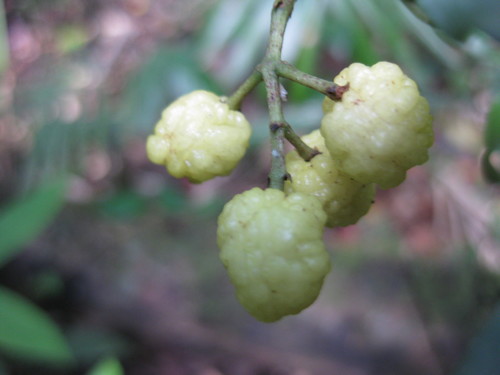
Zanthoxylum chalybeum
Engl.
Gadda

(c) Bart Wursten, some rights reserved (CC BY-NC), uploaded by Bart Wursten

(c) bryanadkins, some rights reserved (CC BY-NC)
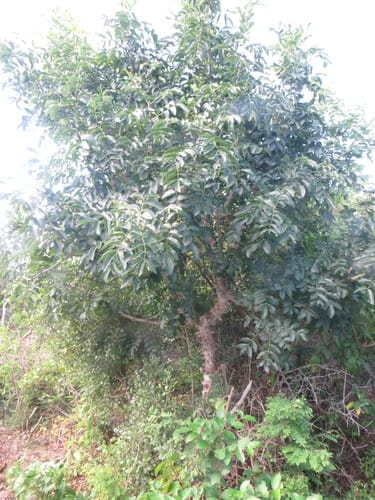
(c) Wasini Tour Guide, some rights reserved (CC BY-NC)
What to Eat
Edible parts: Leaves, Bark, Fruit, Vegetable, Seeds
The aromatic leaves and fruit are used to flavor tea and as a vegetable; they can be pounded, dried, and stored. The bark is also used to make tea and flavor soups.
Where to Find It
It is a tropical plant. It grows in the lowlands. It grows in dry woodland and on termite mounds. In Kenya it grows from sea level to 1,800 m altitude. It grows on coastal sands and well-drained red clay soils. It can grow in arid places.
Africa, Burundi, Central Africa, Congo DR, East Africa, Ethiopia, Kenya, Lesotho, Malawi, Mozambique, Namibia, Rwanda, Somalia, South Africa, Southern Africa, Sudan, Tanzania, Uganda, Zambia, Zimbabwe,
How to Identify
A shrub or small tree. It loses its leaves during the year. It grows 6 m tall. The crown is broad and dense. It has prickly processes on the trunk. The leaves are 6-20 cm long. There are 2-5 leaflets. The leaflet blades are 3-7 cm long by 1-3 cm wide. They are narrowly oval. The flower panicle is 9 cm long. It is at the base of new branches. Male and female flowers are separate. The fruit are about 6 mm across. The seed is black and shiny.
Nutrition Score: 49/100
| Part | Moisture | kJ | kcal | Protein | Vit A | Vit C | Iron | Zinc |
|---|---|---|---|---|---|---|---|---|
| Leaves | 57 | 275 | 66 | 14 | — | — | — | — |
| Fruit dry | 11 | — | — | 8.5 | — | — | 21.8 | — |
How to Grow
Plants can be grown from seeds or root suckers. Plants can be cut back and allowed to re-grow.
Propagation: Seed - best sown as soon as it is ripe.
Medicinal Uses
In parts of Kenya, Uganda and Somalia, a leaf decoction is used for the treatment of diarrhea, throat, stomach and chest pain. The leaves are also cooked and eaten as a vegetable or brewed and drunk as tea. Stem bark and root extracts are used in decoctions to treat malaria.
Other Uses
The twigs are used as toothbrushes. The wood is very hard, heavy, elastic and highly durable. It works well, although it is difficult to nail; finishes and polishes well. It has been used for carving, turnery, building poles, bedsteads, spoons, stools, drums, walking sticks etc. The wood makes a good fuel, burning easily.
Wikipedia
Source ↗Zanthoxylum chalybeum is an aromatic deciduous shrub or tree within the family Rutaceae. It is also known as the lemon scented knobwood.
Production
It is slow growing. Leaves are collected during the rainy season and early dry season.
Other Information
It is a popular vegetable.
Names & Synonyms
Cipolo, Cipupa, Dedeho, Hombomuungu, Iguga, Igugu, Ketata, Keta'ata, Kettata, Loisuki, Mdung, Mhunngu, Mjafari, Mkonta, Mkunungu, Mlenda, Mlungulungu, Mukana, Mukenea, Mukundanyoka, Murongo, Oluisuki, Pupwe, Pupwe chulu, Pupwekyulu
References (26)
- Addis, G., Asfaw, Z & Woldu, Z., 2013, Ethnobotany of Wild and Semi-wild Edible Plants of Konso Ethnic Community, South Ethiopia. Ethnobotany Research and Applications. 11:121-141
- Addis, G., et al, 2013, The Role of Wild and Semi-wild Edible Plants in Household Food Sovereignty in Hamer and Konso Communities, South Ethiopia. Ethnobotany Research & Applications. 11:251-271
- Balemie, K., & Kebebew, F., 2006, Ethnobotanical study of wild edible plants in Derashe and Kucha Districts, South Ethiopia. Journal of Ethnobiology and Ethnomedicine. 2:53
- Drummond, R. B., 1981, Common Trees of the Central Watershed Woodlands of Zimbabwe, National Herbarium Salisbury. p 100
- East African Herbarium records, 1981,
- Flora Zambesiaca. http://apps.kew.org/efloras
- Fowler, D. G., 2007, Zambian Plants: Their Vernacular Names and Uses. Kew. p 59
- Grivetti, L. E., 1980, Agricultural development: present and potential role of edible wild plants. Part 2: Sub-Saharan Africa, Report to the Department of State Agency for International Development. p 47 (As Fagara chalybea)
- Grubben, G. J. H. and Denton, O. A. (eds), 2004, Plant Resources of Tropical Africa 2. Vegetables. PROTA, Wageningen, Netherlands. p 566
- http://www.fao.org/forestry/25323-096344a3de335832e8f363c3ac5184a66.pdf
- Malaisse, F., 1997, Se nourrir en floret claire africaine. Approche ecologique et nutritionnelle. CTA., p 69
- Le Houerou, H. N., (Ed.), 1980, Browse in Africa. The current state of knowledge. International Livestock Centre for Africa, Ethiopia. p 163 (As Fagara chalybea)
- Luoga, E. J., et al, 2000, Differential Utilization and Ethnobotany of Trees in Kitulanghalo Forest Reserve and Surrounding Communal Lands, Eastern Tanzania. Economic Botany, Vol. 54, No. 3, pp. 328-343
- Martin, F. W., et al, 1987, Perennial Edible Fruits of the Tropics. USDA Handbook 642 p 75 (As Fagara chalybea)
- Martin, F.W. & Ruberte, R.M., 1979, Edible Leaves of the Tropics. Antillian College Press, Mayaguez, Puerto Rico. p 217 (As Zanthoxylum olitorium)
- Maundu, P. et al, 1999, Traditional Food Plants of Kenya. National Museum of Kenya. 288p
- Mbuya, L.P., Msanga, H.P., Ruffo, C.K., Birnie, A & Tengnas, B., 1994, Useful Trees and Shrubs for Tanzania. Regional Soil Conservation Unit. Technical Handbook No 6. p 518
- Msuya, T. S., et al, 2010, Availability, Preference and Consumption of Indigenous Foods in the Eastern Arc Mountains, Tanzania, Ecology of Food and Nutrition, 49:3, 208-227
- Mutie, F. G., 2020, Conservation of Wild Food Plants and Their Potential for Combatting Food Insecurity in Kenya as Exemplified by the Drylands of Kitui County. Plants 2020, 9, 1017
- Mutie, F. M., et al, 2023, Important Medicinal and Food Taxa (Orders and Families) in Kenya, Based on Three Quantitative Approaches. Plants 2023, 12, 1145
- Perennial Edible Fruit (As Fagara chalybea)
- Peters, C. R., O'Brien, E. M., and Drummond, R.B., 1992, Edible Wild plants of Sub-saharan Africa. Kew. p 178
- Royal Botanic Gardens, Kew (1999). Survey of Economic Plants for Arid and Semi-Arid Lands (SEPASAL) database. Published on the Internet; http://www.rbgkew.org.uk/ceb/sepasal/internet [Accessed 10th June 2011]
- Ruffo, C. K., Birnie, A. & Tengnas, B., 2002, Edible Wild Plants of Tanzania. RELMA p 74
- World Checklist of Useful Plant Species 2020. Royal Botanic Gardens, Kew
- www.worldagroforestrycentre.org/treedb/