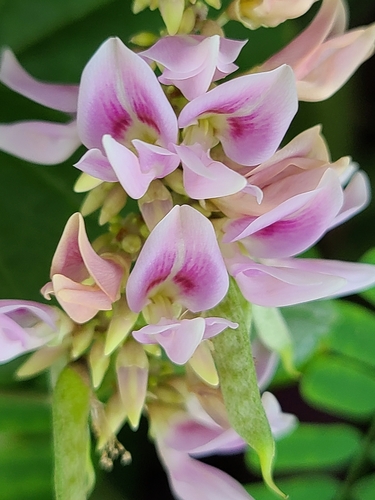
Parkia nitida
Miq.
Black nittatree
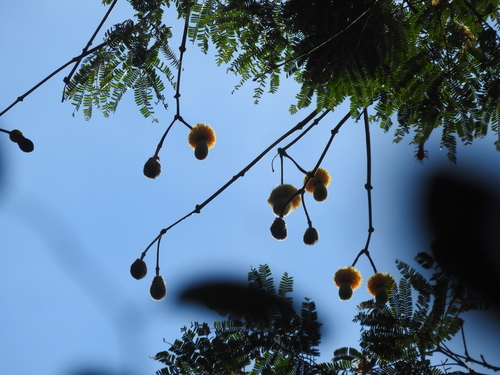
(c) Sébastien SANT, some rights reserved (CC BY-NC), uploaded by Sébastien SANT
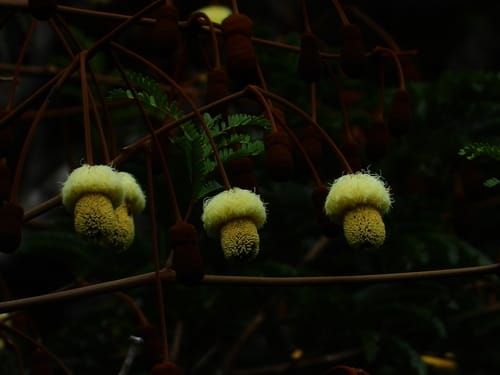
(c) Sébastien SANT, some rights reserved (CC BY-NC)
What to Eat
Edible parts: Seeds, Fruit pods
The young fruit pods and seeds are eaten.
Where to Find It
It is a tropical plant. It grows in wet forest.
Amazon, Bolivia, Brazil, Central America, Colombia, Ecuador, French Guiana, Guianas, Guyana, Panama, Peru, South America, Suriname, Venezuela,
How to Identify
A tall tree. It grows 35 m tall. The trunk is light brown and smooth. The leaves are compound and twice divided. The leaves are almost opposite. The flowers are white in round balls. The fruit are pods 15-32 cm long by 7-9 cm wide. There are 8-13 seeds. These are narrowly oval and black.
How to Grow
A plant of the moist tropics, mainly found at low elevations, but also ascending to 1,500 metres. Grows best in a sunny position. Succeeds in wet and dry soils. Newly planted young trees establish well and grow away quickly. Although many species within the family Fabaceae have a symbiotic relationship with soil bacteria, this species is said to be devoid of such a relationship and therefore does not fix atmospheric nitrogen.
Propagation: Seed - it has a hard seedcoat and needs scarification before sowing to speed up germination. This can usually be done by pouring a small amount of nearly boiling water on the seeds (being careful not to cook them!) and then soaking them for 12 - 24 hours in warm water. By this time they should have imbibed moisture and swollen - if they have not, then carefully make a nick in the seedcoat (being careful not to damage the embryo) and soak for a further 12 hours. Sow the seed in a sunny position in a nursery seedbed or in individual containers. Germination rates are usually in excess of 50%, with the seed sprouting within 3 - 4 weeks.
Medicinal Uses
The bark is used in traditional medicine.
Other Uses
The heartwood is creamy white, sometimes with very large light brown veins; it os not demarcated from the sapwood. The texture is medium; the grain straight or interlocked. The wood is very light to light in weight, soft; not very durable, being susceptible to fungi, dry wood borers and termites. It seasons fairly quickly, with a high risk of checking and distortion; once seasoned it is poorly stable in service. It can be worked with ordinary tools, though there is a risk of fuzzy surfaces; nailing and screwing are poor; gluing is correct. A low quality wood, it is used for purposes such as interior panelling and joinery, furniture components, boxes and crates, moulding, blockboard and veneer. The wood is used for fuel.
Notes
Also as Mimosaceae. The bark is used in medicine.
Names & Synonyms
Ajo, Arapary branco, Arara-tucupi, Bellaco caspi, Black manariballi, Caro blanco, Cor, Dormilon, Emu ca'je, Fava esponja, Faveira, Ginetawebe, Goma pashaca, Guarango, Paric, Pellijo de sapo, Talar, Visgueiro
References (9)
- Condit, R., et al, 2011, Trees of Panama and Costa Rica. Princeton Field Guides. p 208
- Forest and Wood Products Progam. Illustrated Booklet of 25 Forest Species of Putumayo, Colombia p 50
- Grandtner, M. M., 2008, World Dictionary of Trees. Wood and Forest Science Department. Laval University, Quebec, Qc Canada. (Internet database http://www.wdt.qc.ca)
- Grandtner, M. M. & Chevrette, J., 2013, Dictionary of Trees, Volume 2: South America: Nomenclature, Taxonomy and Ecology. Academic Press p 482
- ILDIS Legumes of the World http:www:ildis.org/Legume/Web
- Kermath, B. M., et al, 2014, Food Plants in the Americas: A survey of the domesticated, cultivated and wild plants used for Human food in North, Central and South America and the Caribbean. On line draft. p 607
- Lopez-Diago, D. & Garcia, N., 2021, Wild edible fruits of Colombia. Biota ColomBiana 22 (2) p 39
- Roa, J. A. G. & Boada, D. S. G., 2018, Fundación para el Fortalecimiento de la Fruticultura y Plantas Alimenticias no Convencionales en Colombia.
- Torre, de la, L., et al, 2008, Enciclopedia de las Plantas Útiles del Ecuador. Herbario QCA. Pontificia Universidad Católica del Ecuador. p 355