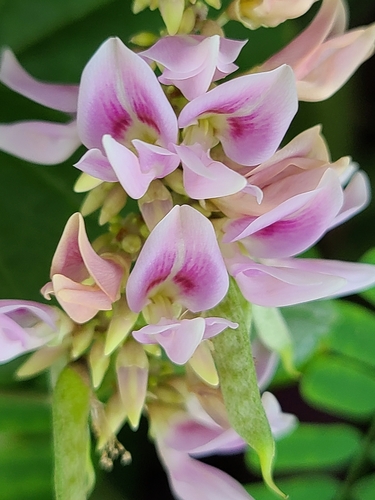
Cyclopia falcata
(Harvey) Kies
Bush tea

iNaturalist · cc-by-nc
(c) Nick Helme, some rights reserved (CC BY-NC), uploaded by Nick Helme
(c) Nick Helme, some rights reserved (CC BY-NC), uploaded by Nick Helme

iNaturalist · cc-by-nc
(c) Nick Helme, some rights reserved (CC BY-NC)
(c) Nick Helme, some rights reserved (CC BY-NC)
What to Eat
Edible parts: Leaves - tea, Stems - tea, Flowers - tea
The stems, leaves, and flowers are all used to make tea drinks.
Where to Find It
It grows in Mediterranean climate areas. It can grow in arid places. It occurs on Table Mountain sandstone between 550-1,600 m above sea level.
Africa, South Africa*, Southern Africa,
Countries: Angola, Burkina Faso, Burundi, Benin, Botswana, Congo (DRC), Central African Republic, Congo (Republic), Cote d'Ivoire, Cameroon, Cape Verde, Djibouti, Algeria, Egypt, Eritrea, Ethiopia, Gabon, Ghana, Gambia, Guinea, Equatorial Guinea, Guinea-Bissau, Kenya, Comoros, Liberia, Lesotho, Libya, Morocco, Madagascar, Mali, Mauritania, Mauritius, Malawi, Mozambique, Namibia, Niger, Nigeria, Rwanda, Seychelles, Sudan, Sierra Leone, Senegal, Somalia, South Sudan, Sao Tome & Principe, Eswatini, Chad, Togo, Tunisia, Tanzania, Uganda, South Africa, Zambia, Zimbabwe
How to Identify
A shrub in the Fabaceae family that grows in Mediterranean climate areas and arid places, occurring on Table Mountain sandstone between 550–1,600 m above sea level. It regenerates from a woody rootstock after fire.
How to Grow
It re-grows from a woody rootstock after fire.
Notes
The bacteria producing nodules are by Burkholderia tuberum.
Names & Synonyms
Cyclopia subternata VogelCyclopia vogelii var. falcata Harv.
References (7)
- ILDIS Legumes of the World http:www:ildis.org/Legume/Web
- Kew Plants of the World On line
- Ruiters-Welcome, A. K., 2019, Food plants of southern Africa. Ph.D. thesis. Univ. of Johannesburg p 57
- Royal Botanic Gardens, Kew (1999). Survey of Economic Plants for Arid and Semi-Arid Lands (SEPASAL) database. Published on the Internet; http://www.rbgkew.org.uk/ceb/sepasal/internet [Accessed 28th April 2011]
- van Wyk, Ben-Erik, 2019, The diversity and multiple uses of southern African legumes. Australian Systematic Botany, 2019, 32, 519–546
- Welcome, A. K. & Van Wyk, B.-E., 2019, An inventory and analysis of the food plants of southern Africa. South African Journal of Botany 122 (2019) 136–179
- World Checklist of Useful Plant Species 2020. Royal Botanic Gardens, Kew