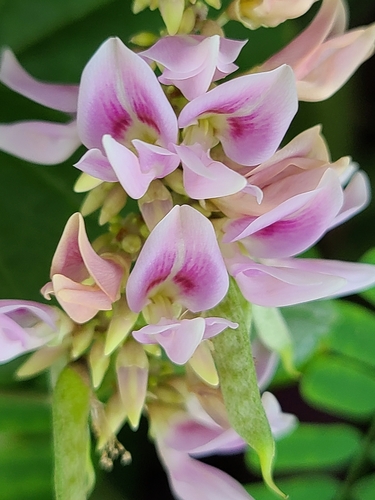
Leucaena cuspidata
Standley
Efe, Efe de Cerro, Huaxi

(c) Neptalí Ramírez Marcial, some rights reserved (CC BY), uploaded by Neptalí Ramírez Marcial

(c) Neptalí Ramírez Marcial, some rights reserved (CC BY)
What to Eat
Edible parts: Pods
Immature seed - raw or cooked. Often eaten raw as a snack when working in the field, Leucaena seeds are also often used as a garnish on cooked foods or added to stews, mixed with beans and maize tortillas etc. After removal from the pods, the unripe seeds can be dried and stored for later use or ground into a flour and mixed with wheat, corn etc. The seeds are 8 - 10mm wide x 9 - 12mm long. We have no record of edibility for the seedpods of this species, but the immature seedpods of many species in Mexico are eaten raw or cooked. The seedpods are green and tleshy unripe, turning mid reddish-brown; they are 10 - 28cm long and 2 - 3cm wide, containing 13 - 15 seeds. There are 1 - 2, occasionally 3 pods per flower head.
Where to Find It
It is a tropical plant.
Central America, Mexico, North America,
How to Identify
A tropical shrub or small tree of the Fabaceae family.
How to Grow
Leucaena cuspidata is native to mid-elevation, dry, inland hills and plateaux of southern Mexico, where it can experience light to moderate frosts for up to 3 monhs of the year. It grows in areas where the mean annual rainfall is in the range of 500 - 1,200mm, with a dry season of up to 6 months. Leucaena species generally require a sunny position. They are often found in the wild on poor, shallow and dry soils, usually overlying a calcareous rock. Most of them do not thrive on acid soils. Most species experience a long dry season and are more or less drought tolerant. Leucaena cuspidata is one of only five species in this genus judged to have a low risk of weediness due to its sparse and delayed seed production. Unlike the majority of species of Leucaena, it does not appear to thrive on disturbance. The unripe seedpods are harvested by climbing the trees and lopping the terminal branches or groups of pods, often crudely, with machetes, small knives or cutting poles. Annual pollarding in this way apparently causes only limited damage to the trees which resprout and fruit annually. Limited data suggest that this species is moderately or highly psyllid-resistant. This species has a symbiotic relationship with certain soil bacteria, these bacteria form nodules on the roots and fix atmospheric nitrogen. Some of this nitrogen is utilized by the growing plant but some can also be used by other plants growing nearby.
Propagation: Seed - it has a hard seedcoat and may benefit from scarification before sowing in order to speed up germination. This can usually be done by pouring a small amount of nearly boiling water on the seeds (being careful not to cook them!) and then soaking them for 12 - 24 hours in warm water. By this time they should have imbibed moisture and swollen - if they have not, then carefully make a nick in the seedcoat (being careful not to damage the embryo) and soak for a further 12 hours before sowing. The seed retains its viability for a long period if stored under conditions of less than 10 % moisture content at less than 4°c in hermetically sealed containers.
Wikipedia
Source ↗Leucaena cuspidata is a species of flowering plant in the family Fabaceae. It is found only in Mexico. It is threatened by habitat loss.
Notes
Also as Mimosaceae.
Names & Synonyms
References (4)
- Argel, P. J., Lascano, C. E. and Ramirez, L., 1998, Leucaena in Latin American Farming Systems: Challenges for Development. Paper at workshop on Leucaena in Hanoi.
- ILDIS Legumes of the World http:www:ildis.org/Legume/Web
- Kew Plants of the World On line
- Mapes, C. & Basurto, F., 2016, Biodiversity and Edible Plants of Mexico. Chapter 5 in R. Lira, et al. (eds.), Ethnobotany of Mexico, Ethnobiology, Springer. p 94