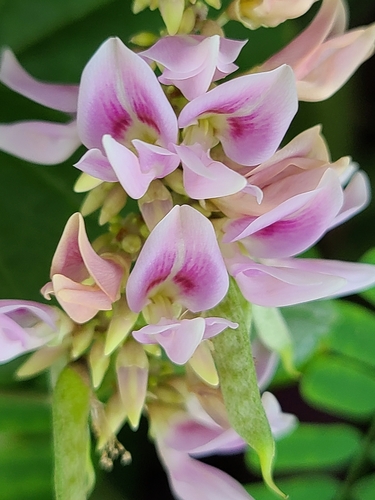
Leucaena macrophylla
Benth.
Calguje, Frijolito, Guaje blanco

(c) Carlos Domínguez-Rodríguez, some rights reserved (CC BY-NC), uploaded by Carlos Domínguez-Rodríguez

(c) Carlos Domínguez-Rodríguez, some rights reserved (CC BY-NC)
What to Eat
Edible parts: Pods
Leucaena species are grown for their variety of uses, including as green manure, a charcoal source, livestock fodder, and for soil conservation. The seeds (jumbie beans) can be used as beads. Leucaena planted for firewood on an area of 120 km2 (46 sq mi) will yield an energy equivalent of 1 million barrels of oil per year. Anthelmintic medicines are made from extracts of Leucaena seeds in Sumatra, Indonesia. Some species (namely Leucaena leucocephala) have edible fruits (as unripe) and seeds. The seeds of Leucaena esculenta (in Mexico called guaje or huaje) are eaten with salt in Mexico. In other species high levels of mimosine may lead to hair loss and infertility in non-ruminants.
Where to Find It
It is a tropical plant.
Central America, Mexico, North America,
How to Identify
A tropical tree of the legume family (Fabaceae) with large compound leaves.
How to Grow
Leucaena macrophylla subspecies macrophylla is found at moderately high elevations to 1,900 metres in southern Mexico. It is more cold tolerant than subspecies istmensis, but does not withstand frost. It is found in areas of seasonal rainfall, with a mean annual rainfall in the range 700 - 1,500mm and a 4 - 6 month dry season. Leucaena species generally require a sunny position. They are often found in the wild on poor, shallow and dry soils, usually overlying a calcareous rock. Most of them do not thrive on acid soils. Most species experience a long dry season and are more or less drought tolerant. The plant is a common element of secondary vegetation and has the potential to spread under open ruderal conditions and become a weed The unripe seedpods are harvested by climbing the trees and lopping the terminal branches or groups of pods, often crudely, with machetes, small knives or cutting poles. Annual pollarding in this way apparently causes only limited damage to the trees which resprout and fruit annually. The tree is moderately susceptible to damage by psyllids1518]. This species has a symbiotic relationship with certain soil bacteria, these bacteria form nodules on the roots and fix atmospheric nitrogen. Some of this nitrogen is utilized by the growing plant but some can also be used by other plants growing nearby.
Propagation: Seed - it has a hard seedcoat and may benefit from scarification before sowing to speed up germination. This can usually be done by pouring a small amount of nearly boiling water on the seeds (being careful not to cook them!) and then soaking them for 12 - 24 hours in warm water. By this time they should have imbibed moisture and swollen - if they have not, then carefully make a nick in the seedcoat (being careful not to damage the embryo) and soak for a further 12 hours before sowing. Cuttings of semi-ripe wood. Vegetative propagation has been successful in relatively few locations, reflecting critical environmental requirements, or possibly systemic fungi. The use of bare-root cuttings has worked in Indonesia, Taiwan and Thailand.
Other Uses
The wood density is around average foe a species of Leucaena, with moderate formation of heartwood. Of small dimensions, it is used mainly as a fuel. The plant is a common element of secondary vegetation and has the potential to spread under open ruderal conditions and become a weed. With the added bonus of fixing atmospheric nitrogen, this sounds like a good pioneer species for use in restoring native woodland.
Notes
Also as Mimosaceae.
Names & Synonyms
References (7)
- Argel, P. J., Lascano, C. E. and Ramirez, L., 1998, Leucaena in Latin American Farming Systems: Challenges for Development. Paper at workshop on Leucaena in Hanoi.
- Casas, A., et al, 1996, Plant Management Among the Nahua and the Mixtec in the Balsas River Basin, Mexico: An Ethnobotanical Approach to the Study of Plant Domestication. Human Ecology, Vol. 24, No. 4 pp. 455-478
- Cruz, I. M., et al, 2015, Edible fruits and seeds in the State of Mexico. Revista Mexicana de Ciencias Agricolas. Vol. 6. Num. 2 pp 331-346
- ILDIS Legumes of the World http:www:ildis.org/Legume/Web
- Mapes, C. & Basurto, F., 2016, Biodiversity and Edible Plants of Mexico. Chapter 5 in R. Lira, et al. (eds.), Ethnobotany of Mexico, Ethnobiology, Springer. p 94
- Segura, S., et al, 2018, The edible fruit species in Mexico. Genet Resour Crop Evol (2018) 65:1767–1793
- World Checklist of Useful Plant Species 2020. Royal Botanic Gardens, Kew