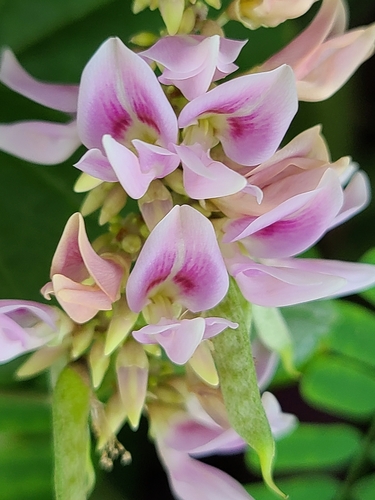
Ononis spinosa
L.
Spiny restharrow
(c) mathias_s, some rights reserved (CC BY-NC), uploaded by mathias_s

(c) Nuuuuuuuuuuul, some rights reserved (CC BY)

(c) Markus Greiner, some rights reserved (CC BY-NC), uploaded by Markus Greiner
What to Eat
Edible parts: Shoots, Root, Flowers, Leaves
Young shoots can be cooked and used as a potherb. The roots are chewed for their liquorice-like flavour. The flowers are eaten raw and used as a decoration on salads.
Where to Find It
It is a temperate or Mediterranean plant. It grows in chalk and limestone grassland. It is usually in dry stony ground. It is best with well-drained soil. It needs a sunny position. It is hardy to hardiness zone 6.
Afghanistan, Africa, Albania, Algeria, Asia, Australia, Austria, Balkans, Belgium, Bosnia, Britain, Bulgaria, China, Czech Republic, Denmark, Europe, Finland, France, Germany, Greece, Hungary, Iran, Iraq, Ireland, Israel, Italy, Jordan, Lebanon, Libya, Luxembourg, Macedonia, Mediterranean, Middle East, Morocco, Netherlands, New Zealand, North Africa, Norway, Pakistan, Poland, Portugal, Romania, Russia, Scandinavia, Slovenia, Spain, Sweden, Switzerland, Syria, Tasmania, Tunisia, Turkey, Türkiye, Yugoslavia,
How to Identify
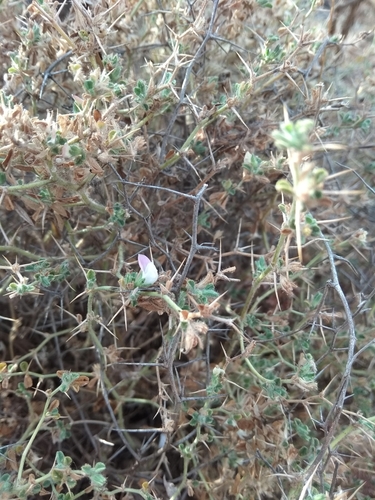
A shrub. It keeps growing from year to year. It grows 60 cm tall. It has thorns or spines. The leaves are alternate and have 3 leaflets. The flowers are pea like and pale purple. It is a legume and produces nodules. The fruit is a pod with one seed. The seeds are kidney shaped. The seeds can be green, brown or black. They have a rough surface.
How to Grow
Prefers a sunny position in a well-drained neutral to alkaline soil. Succeeds in poor soils, the plant often becoming spiny in such a situation. Similar to O. repens but this species is not rhizomatous. Mature roots are very tough and the plant gained its common name of 'Rest Harrow' because ploughs and harrows would be unable to break through it (in the days before heavy machinery was used on the land!). The whole plant is pleasantly scented when bruised. This species has a symbiotic relationship with certain soil bacteria, these bacteria form nodules on the roots and fix atmospheric nitrogen. Some of this nitrogen is utilized by the growing plant but some can also be used by other plants growing nearby.
Propagation: Scarify or pre-soak seed for 24 hours in warm water, then sow in mid-spring in situ. Seed can also be sown in a cold frame in autumn. Prick seedlings into individual pots when large enough to handle and plant out in late spring. Divide just before new growth begins in spring — larger divisions can go directly into permanent positions, while smaller divisions are better potted up and grown on in light shade in a cold frame until well established before planting out in late spring or early summer. Cuttings in September in a cold frame.
Medicinal Uses
The roots, leaves, and flowers are antitussive, aperient, diuretic, and lithontripic. The root contains a fixed oil with anti-diuretic properties and an essential oil with diuretic properties. When the diuretic action is required, the root should be prepared as an infusion rather than a decoction, as boiling will evaporate the essential oil. An infusion is used to treat dropsy, inflammation of the bladder and kidneys, rheumatism, and chronic skin disorders. The roots are used occasionally — harvested in autumn, sliced, and carefully dried for later use. The young shoots are more commonly used, either fresh or dried, and can be harvested throughout the summer. A cough mixture is made from the bark.
Other Uses
Nitrogen fixer.
Wikipedia
Source ↗Ononis spinosa is a flowering plant belonging to the family Fabaceae, that is commonly known as spiny restharrow or just restharrow. It is found throughout much of Europe including Britain, but rarely as far north as Scotland. It is closely related to Ononis repens (common restharrow); the two are considered conspecific by the Plants of the World Online database, with O. repens treated as a subspecies of O. spinosa as Ononis spinosa subsp. procurrens. The Botanical Society of Britain and Ireland treats them as separate species.
Names & Synonyms
Gladisika, Kayışkıran, Navadni gladež, Zecju trn
References (7)
- Cerne, M., 1992, Wild Plants from Slovenia used as Vegetables. Acta Horticulturae 318
- Ertug, F, Yenen Bitkiler. Resimli Türkiye Florası -I- Flora of Turkey - Ethnobotany supplement
- http://www.botanic-gardens-ljubljana.com/en/plants
- ILDIS Legumes of the World http:www:ildis.org/Legume/Web
- Mahklouf, M. H., 2019, Ethnobotanical Study of Edible Wild Plants in Libya. European Journal of Ecology. 5(2): 30-40
- Redzic, S. J., 2006, Wild Edible Plants and their Traditional Use in the Human Nutrition in Bosnia-Herzegovina. Ecology of Food and Nutrition, 45:189-232
- Tasmanian Herbarium Vascular Plants list p 30