Cerinthe major
L.
Waxplant
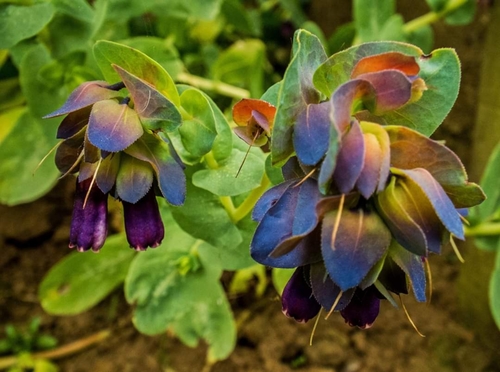
(c) johnh123, some rights reserved (CC BY-NC)

(c) Hans Hillewaert, some rights reserved (CC BY-SA)
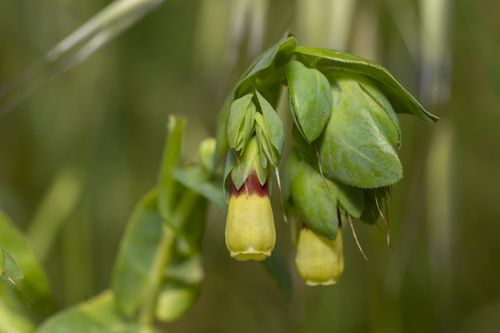
(c) Eleftherios Katsillis, some rights reserved (CC BY), uploaded by Eleftherios Katsillis
What to Eat
Edible parts: Leaves, Flowers
The young leaves and flowers are eaten raw in salads or cooked.
Where to Find It
It is best in a rich well-drained soil. It needs an open sunny position. It is resistant to drought and frost.
Australia, Caucasus*, Europe, Italy, Mediterranean, Sicily, Slovenia, Turkey, Türkiye,
How to Identify
A plant that grows for 2 or more years. It grows 40 cm high and spreads 40 cm wide. The stem is erect and branching. The leaves are smooth. The flowers are purple to yellow. They are bell shaped.
How to Grow
Plants can be grown by seed or by root division.
Medicinal Uses
The young leaves and flowers are used in traditional preparations.
Wikipedia
Source ↗Cerinthe major, called honeywort along with other members of its genus, is an annual species of flowering plant in the genus Cerinthe, native to the Mediterranean region (southern Europe, western Asia and northern Africa), and introduced to New Zealand. Gardeners have a choice along a spectrum of cultivars ranging from Cerinthe major subsp. major, with sea-green bracts and yellow flowers, to Cerinthe major subsp. purpurascens with blue bracts and purple flowers.
Names & Synonyms
Sucamele, Velika voščica
References (7)
- Biscotti, N. & Pieroni, A., 2015, The hidden Mediterranean diet: wild vegetables traditionally gathered and consumed in the Gargano area, Apulia, SE Italy. Acta Societatis Botanicorum Poloniae 84 (3): 327-338
- Biscotti, N. et al, 2018, The traditional food use of wild vegetables in Apulia (Italy) in the light of Italian ethnobotanical literature. Italian Botanist 5:1-24
- Bodkin, F., 1991, Encyclopedia Botanica. Cornstalk publishing, p 241
- Ertug, F., 2004, Wild Edible Plants of the Bodrum Area. (Mugla, Turkey). Turk. J. Bot. 28 (2004): 161-174
- Ertug, F, Yenen Bitkiler. Resimli Türkiye Florası -I- Flora of Turkey - Ethnobotany supplement
- Geraci, A., et al, 2018, The wild taxa utilized as vegetables in Sicily (Italy): a traditional component of the Mediterranean diet. Journal of Ethnobiology and Ethnomedicine (2018) 14:14
- Pasta, S., et al, 2020, An Updated Checklist of the Sicilian Native Edible Plants: Preserving the Traditional Ecological Knowledge of Century-Old Agro-Pastoral Landscapes. Frontiers in Plant Science. Volume 11|Article 388