Cajanus goensis
Dalzell
Katori peren
(c) 刘光裕 Liu Guangyu, some rights reserved (CC BY-NC), uploaded by 刘光裕 Liu Guangyu

(c) MP Zhou, some rights reserved (CC BY-NC)

(c) MP Zhou, some rights reserved (CC BY-NC)
What to Eat
Edible parts: Seeds, Leaves
The seeds are used in soups, and the leaves are also eaten.
Where to Find It
It is a tropical plant. In southern China it grows between 1,000-1,300 m above sea level. In Yunnan.
Asia, Bangladesh, China, Himalayas, India, Indochina, Indonesia, Laos, Malaysia, Myanmar, Northeastern India, SE Asia, Thailand, Vietnam,
How to Identify
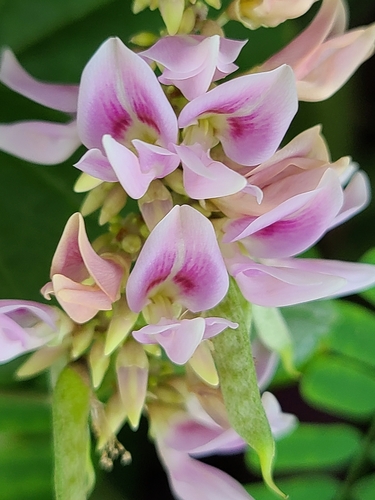
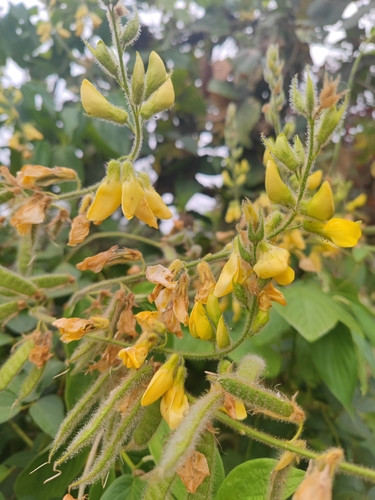
A bean. It is a woody twining vine. It can grow several metres tall. The young stems are hairy. The leaves have 3 leaflets. The leaf stalk is 3-7 cm long. The end leaflet is oval and 5-10 cm long by 4-5 cm wide. The base is rounded and they taper to the tip. The flowers are about 3 cm across. The pod is 4-6 cm long by 1 cm wide. It is straight and hairy. There are 5-7 brown seeds.
Names & Synonyms
Mi yor por, Som
References (3)
- Gangwar, A. K. & Ramakrishnan, P. S., 1990, Ethnobotanical Notes on Some Tribes of Arunachal Pradesh, Northeastern India. Economic Botany, Vol. 44, No. 1 pp. 94-105 (As Atylosia goensis)
- Kew Plants of the World Online
- Sutjaritjai, N., et al, 2019, Traditional Uses of Leguminosae among the Karen in Thailand. Plants 2019, 8, 600 p 5