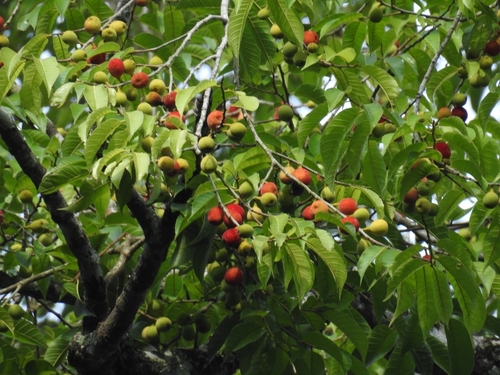
Ficus hirta subsp. roxburghii
(King) C. C. Berg.
MoraceaeFruit

gbif · cc0
Royal Botanic Garden Edinburgh
Royal Botanic Garden Edinburgh

gbif · cc-by
The New York Botanical Garden
The New York Botanical Garden

gbif · cc-by
The New York Botanical Garden
The New York Botanical Garden
What to Eat
Edible parts: Fruit
The ripe fruit are eaten fresh, and the unripe fruit are cooked as a vegetable.
Where to Find It
It is a subtropical plant. In the Indian Himalayas it grows between 700-1,900 m above sea level.
Asia, Bangladesh, Himalayas, India, Indonesia, Malaysia, Myanmar, Northeastern India, SE Asia, Sikkim, Vietnam,
Countries: United Arab Emirates, Afghanistan, Armenia, Azerbaijan, Bangladesh, Bahrain, Brunei, Bhutan, China, Georgia, Indonesia, Israel, India, Iraq, Iran, Jordan, Japan, Kyrgyzstan, Cambodia, North Korea, South Korea, Kuwait, Kazakhstan, Laos, Lebanon, Sri Lanka, Myanmar, Mongolia, Maldives, Malaysia, Nepal, Oman, Philippines, Pakistan, Qatar, Saudi Arabia, Singapore, Syria, Thailand, Tajikistan, Timor-Leste, Turkmenistan, Turkey, Taiwan, Uzbekistan, Vietnam, Yemen
How to Identify
A fig. It is a shrub or tree up to 15 m tall. The leafy twigs are often hollow. The leaves are narrowly oval with lobes spread out like fingers on a hand. There are 3-7 lobes. The leaves are 10-40 cm long by 6-40 cm wide. The fruit are figs without stalks.
Other Information
It is cultivated.
Names & Synonyms
Gular, Timla, Traymbalu
Ficus cordata Ridl.Ficus hirsuta Roxb.Ficus roxburghii Miq.and others
References (9)
- Bohra, N., et al, 2017, Ethnobotany of wild edible plants traditionally used by the local people in the Ramnagar regions from Nainital District, Uttarakhand, India. Biolife 5(1): 12-19 (As Ficus roxburghii)
- Gangwar, A. K. & Ramakrishnan, P. S., 1990, Ethnobotanical Notes on Some Tribes of Arunachal Pradesh, Northeastern India. Economic Botany, Vol. 44, No. 1 pp. 94-105 (As Ficus hirsuta)
- Pandey, Y., Upadhyay, S. & Bhatt, S. S., 2018, Phyto-chemical constituent os some wild edible fruits of Sikkim Himalaya. Journal of Pharmacognosy and Phytochemistry 2018; 7(3): 1045-1047 (As Ficus roxburghii)
- Parmar, C., & Kaushel, M. K., 1982, In Wild Fruits. Kalyani Publishers, New Delhi, India. p 35 (As Ficus roxburghii)
- Sharma, P., et al, 2013, Wild edibles of Murari Devi and surrounding areas in Mandi district of Himachal Pradesh, India. International Journal of Biodiversity and Conservation. Vol. 5(9), pp. 580-592, September 2013 (As Ficus roxburghii)
- Sundriyal, M. & Sundriyal, R. C., 2004, Structure, Phenology, Fruit Yield, and Future Prospects of some Prominent Wild Edible Plant Species of the Sikkim Himalaya, India. Journal of Ethnobiology 24(1): 113-138 (As Ficus roxburghii)
- Suresh, C. P. et al, 2014, Wild Edible Tree Fruits of Sikkim Himalayas. Journal of Tree Sciences 33(1): 43-48 (As Ficus roxburghii)
- Tomar, A., Kumar, A., & Dubey, K., 2002, Underutilized Wild Edible fruits of Nutritional and Medicinal Value. J. Res. Educ. Indian Med., Vol XX1 (As Ficus roxburghii)
- Zeven, A. C. & de West, J. M. J., 1982, Dictionary of cultivated plants and their regions of diversity. Wageningen. p 78 (As Ficus roxburghii)