Convolvulus farinosus
L.
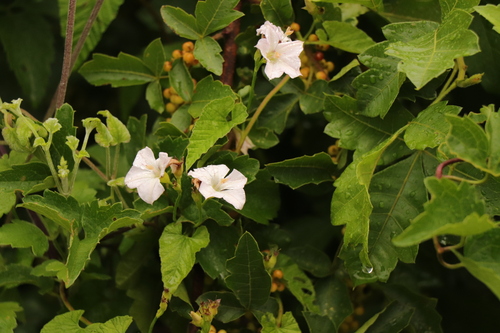
(c) Sandra Falanga, some rights reserved (CC BY-NC), uploaded by Sandra Falanga

(c) Klarissa, some rights reserved (CC BY-NC), uploaded by Klarissa

(c) Klarissa, some rights reserved (CC BY-NC), uploaded by Klarissa
What to Eat
Edible parts: Roots, Vegetable
Young leaves are cooked and eaten, often mixed with other vegetables. The roots are also eaten as a vegetable.
Where to Find It
It is a tropical plant. It grows in grassland between 1,000-2,600 m above sea level.
Africa, Botswana, East Africa, Eritrea, Ethiopia, Kenya, Malawi, Madagascar, Mediterranean, Mozambique, Reunion, South Africa, Southern Africa, Uganda, Tanzania, Zimbabwe,
How to Identify
A herb. It keeps growing from year to year. The stems are long and twining. The leaf blades are oval or triangle shaped. They are alternate. The leaf stalk is 7 cm long. The leaf blade is 3-11 cm long by 4-6 cm wide. The flowering stems are in the axils of leaves and stalks are 6 cm long. They are tube shaped and narrow. The fruit are round capsules 5-8 mm across. There are usually 4 seeds. They are round or 3 sided and black.
How to Grow
Plants can be grown by seed.
Wikipedia
Source ↗Convolvulus farinosus is a species of plant in the family Convolvulaceae. It is native to sub-Saharan Africa.
Production
Leaves are collected during the rainy season.
Other Information
A minor leaf vegetable used when other leaves are scarce.
Names & Synonyms
Enambonhoa, Mrasimwa, Rasimwa
References (6)
- Grubben, G. J. H. and Denton, O. A. (eds), 2004, Plant Resources of Tropical Africa 2. Vegetables. PROTA, Wageningen, Netherlands. p 215
- Johns, T., Mhoro, E. B. and Sanaya, P., 1996, Food Plants and Masticants of the Batemi of Ngorongoro District, Tanzania. Economic Botany, Vol. 50, No. 1, pp. 115-121
- Ruffo, C. K., Birnie, A. & Tengnas, B., 2002, Edible Wild Plants of Tanzania. RELMA p 226
- Ruiters-Welcome, A. K., 2019, Food plants of southern Africa. Ph.D. thesis. Univ. of Johannesburg p 45
- Welcome, A. K. & Van Wyk, B.-E., 2019, An inventory and analysis of the food plants of southern Africa. South African Journal of Botany 122 (2019) 136–179
- World Checklist of Useful Plant Species 2020. Royal Botanic Gardens, Kew


