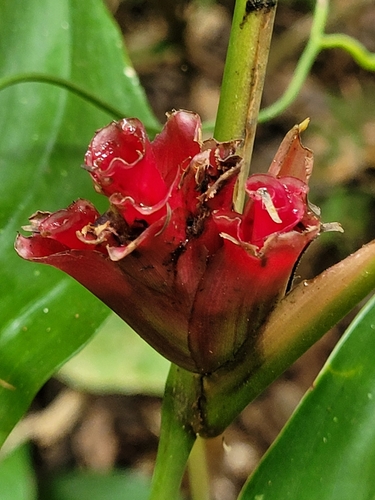
Calathea macrochlamys
Woodson & Standl.

gbif · cc-by-nc
Field Museum of Natural History - Botany Department | NSF/Mellon - GPI
Field Museum of Natural History - Botany Department | NSF/Mellon - GPI

gbif · cc-by-nc
Rapid Reference Collection (RRC) | Field Museum of Natural History - Keller Science Action Center
Rapid Reference Collection (RRC) | Field Museum of Natural History - Keller Science Action Center

gbif · cc0
President and Fellows of Harvard College
President and Fellows of Harvard College
What to Eat
Edible parts: Leaves - spice
The leaves are used as a spice.
Where to Find It
It is a subtropical plant.
Mexico, North America,
Countries: Antigua & Barbuda, Barbados, Bahamas, Belize, Canada, Costa Rica, Cuba, Dominica, Dominican Republic, Grenada, Guatemala, Honduras, Haiti, Jamaica, St Kitts & Nevis, St Lucia, Mexico, Nicaragua, Panama, Puerto Rico, El Salvador, Trinidad & Tobago, United States, St Vincent
How to Identify
An herbaceous plant in the family Marantaceae native to subtropical regions, part of a diverse tropical American genus containing 260-300 species.
Notes
There are 260-300 Calathea species in tropical America.
References (1)
- Ibarra-Manriquez, G., et al, 1997, Useful Plants of the Los Tuxtlas Rain Forest (Veracruz, Mexico): Considerations of their Market Potential. Economic Botany, Vol. 51, No. 4, pp. 362-376