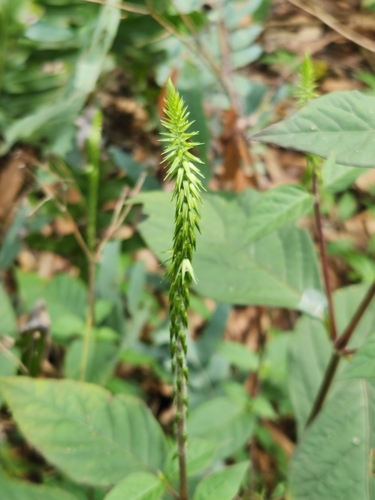
Hermbstaedtia odorata
(Burchell) T. Cooke
Wild cockscomb

(c) tjeerd, some rights reserved (CC BY-NC), uploaded by tjeerd

(c) Grant Reed, some rights reserved (CC BY-NC)

(c) Grant Reed, some rights reserved (CC BY-NC)
What to Eat
Edible parts: Leaves
The leaves are used in vegetable dishes.
Where to Find It
It is a subtropical plant. It grows in hot arid areas. It can be on sandy or loamy soils. It grows below 1,650 m above sea level. It can grow in arid places.
Africa, Botswana, East Africa, Eswatini, Mozambique, Namibia, South Africa, Southern Africa, Swaziland, Zimbabwe,
How to Identify
A herb or small shrub. It is erect and keeps growing from year to year. It has rhizomes or underground stems and grows 75 cm high. The leaves are alternate and 5 cm long by 1 cm wide. They taper at both ends. The flowers are in spikes at the top of the plant and these often droop. The flowers are small, papery and red or orange and in spirals around the stem. There are 3 named varieties.
Names & Synonyms
Eshilalodi, Thepeleshwane, Ubuphuphu, Ubupupu, Umiwandle, Xingalafumana, Xinzilwana
References (7)
- Flyman, M. V. & Afolayan, A. J., 2006, A Survey of plants used as wild vegetables in four districts of Botswana. Ecology of Food and Nutrition, 45:405-415
- Long, C., 2005, Swaziland's Flora - siSwati names and Uses http://www.sntc.org.sz/flora/
- Royal Botanic Gardens, Kew (1999). Survey of Economic Plants for Arid and Semi-Arid Lands (SEPASAL) database. Published on the Internet; http://www.rbgkew.org.uk/ceb/sepasal/internet [Accessed 25th March 2011]
- Ruiters-Welcome, A. K., 2019, Food plants of southern Africa. Ph.D. thesis. Univ. of Johannesburg p 11
- Shackleton, S. E., et al, 1998, Use and Trading of Wild Edible Herbs in the Central Lowveld Savanna Region, South Africa. Economic Botany, Vol. 52, No. 3, pp. 251-259
- Welcome, A. K. & Van Wyk, B.-E., 2019, An inventory and analysis of the food plants of southern Africa. South African Journal of Botany 122 (2019) 136–179
- World Checklist of Useful Plant Species 2020. Royal Botanic Gardens, Kew