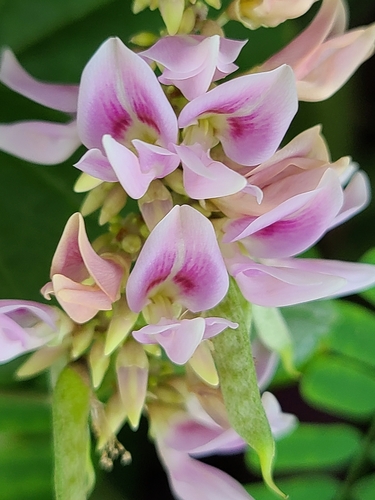
Senna bicapsularis
(L.) Roxby
Christmas senna tree, Rambling cassia
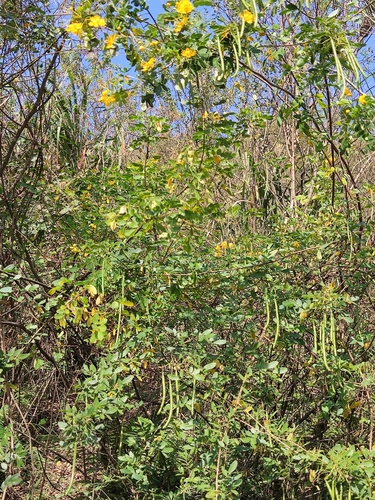
(c) MP Zhou, some rights reserved (CC BY-NC)
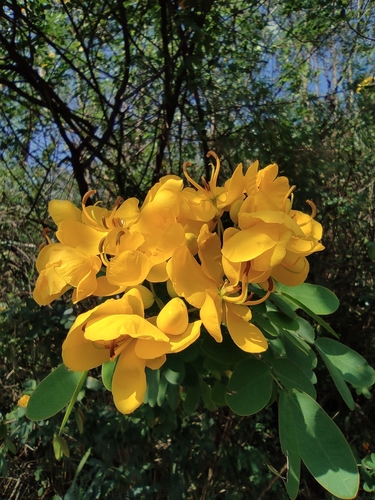
(c) MP Zhou, some rights reserved (CC BY-NC)
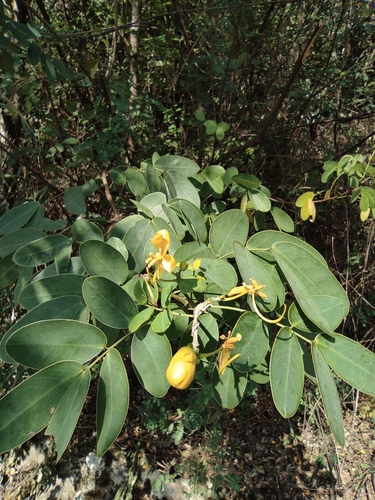
(c) MP Zhou, some rights reserved (CC BY-NC)
What to Eat
Edible parts: Fruit, Leaves, Vegetable, Seeds - coffee, Seeds - oil
The raw fruit has sweet pulp resembling tamarind. The leaves are gathered, chopped, wilted, and cooked as a vegetable. The seeds are roasted, pounded, and used as a coffee substitute, or processed for oil.
Where to Find It
It is a tropical plant. It is invasive of scrub and waste places. It is native of tropical America and now distributed throughout the tropics. It grows between sea level and 2,130 m above sea level. In Tanzania it grows from sea level to 2,100 m above sea level and in areas with a rainfall between 1,100-1,800 mm. It can grow in arid places. It occurs in the West Indies and South America as well as other parts of the tropics. It grows from 1,000-1,900 m altitude in Ethiopia. It grows on light to medium soils. It grows in open sunny positions and on well drained soils. It is drought and frost tender.
Africa, America, Antilles, Asia, Australia, Bermuda, Central America, China, East Africa, Ethiopia, Ghana, Guiana, Guianas, Guyana, Haiti, Indochina, Indonesia, Kenya, Malawi, Mexico, Mozambique, Myanmar, North America, Pacific, Papua New Guinea, PNG, Puerto Rico, SE Asia, Senegal, Sierra Leone, South America*, Suriname, Tanzania, Uganda, USA, Venezuela, Vietnam, West Africa, West Indies, Zambia, Zimbabwe,
How to Identify
A herb or shrub. It is spreading and scrambling. It can grow 2-9 m high. The leaves are green and feather like. The leaves are compound with leaflets along the stalk. There are 2-6 pairs of rounded leaflets. It has oval leaflets 2-4 cm long. The flowers are pale yellow and very large. The stamens inside the flower are curled. The flowers occur in large sprays at the ends of branches. The fruit are a smooth pod 11 cm long and 1 cm wide.
How to Grow
Plants can be grown from seeds. Seed need to have the hard seed coat broken. It can be used as a hedge.
Propagation: Seed - requires pre-treatment to soften the hard seedcoat and allow the ingress of water. This can be done by soaking the seed in a small amount of nearly boiling water (which cools down quickly and does not cook the seed) and then soaking the seed for 12 - 24 hours in warm water. Alternatively, a small area of the seed coat can be abraded, being careful not to damage the embryo.
Medicinal Uses
The Nahuas of San Luis Potosi resort to this plant for the healing of the enchantment. For this reason, the patient is cleaned with seven of its leaves, passing them throughout the body. Likewise, as part of this treatment, while the healer prays, he perfumes the patient's body with a charcoal, rosemary and copal incense and then cleanses it with an egg to remove the "bad air" that has taken possession of his body. The leaves are edible and are used to cure erysipelas in Morelos, and as an antiseptic in Oaxaca. The sap from emaciated leaves can be used externally, with salt, to heal rashes, sores, bites, stings, eczema, scabies, ringworm and thrush. In the 20th century, Maximino Martínez points out the following uses: cathartic and to counteract the effects of arthropod stings. The seedpod flavour resembles tamarind. The leaves can be cooked as a vegetable, which can be mixed with other leaves, beans or peas.
Other Uses
The heartwood is dark brown, the sapwood is yellow. The wood is hard The plant is sometimes used as a hedge.
Wikipedia
Source ↗Senna bicapsularis is a species of the legume genus Senna, native to northern South America, from Panama south to Venezuela and Colombia, and also the West Indies. Common names include rambling senna (formerly "cassia"), winter cassia, Christmas bush, money bush, and yellow candlewood. In Florida, Senna pendula is usually cultivated as, and misapplied to, S. bicapsularis.
Production
Leaves are collected during the early rainy season.
Other Information
The leaves are used in Africa. It is unknown whether they are eaten in Papua New Guinea.
Notes
There are 100 Cassia species. This group has been revised to a smaller more consistent group. Also as Caesalpinaceae.
Names & Synonyms
Alcaparillo, Angor angor, Bicho, Cafe de pobre, Cochimbo, Dan-kywe, Elekmari, Fula butter, Hoja de sen, Pohon kasia sena, Sen del pais, Stiver bush, Wild currant
References (19)
- Asfaw, Z. and Tadesse, M., 2001, Prospects for Sustainable Use and Development of Wild Food Plants in Ethiopia. Economic Botany, Vol. 55, No. 1, pp. 47-62
- Bodkin, F., 1991, Encyclopedia Botanica. Cornstalk publishing, p 220 (As Cassia bicapsularis)
- Burkill, H. M., 1985, The useful plants of west tropical Africa, Vol. 3. Kew.
- Ekman Herbarium records Haiti (As Cassia bicapsularis)
- Facciola, S., 1998, Cornucopia 2: a Source Book of Edible Plants. Kampong Publications, p 67 (As Cassia bicapsularis)
- FAO, 1988, Traditional Food Plants, FAO Food and Nutrition Paper 42. FAO Rome p 162 (As Cassia bicapsularis)
- Grubben, G. J. H. and Denton, O. A. (eds), 2004, Plant Resources of Tropical Africa 2. Vegetables. PROTA, Wageningen, Netherlands. p 564
- Hibbert, M., 2002, The Aussie Plant Finder 2002, Florilegium. p 61 (As Cassia bicapsularis)
- Johns, T., and Kokwaro, J.O., 1991, Food Plants of the Luo of Siayo District, Kenya. Economic Botany 45(1), pp 103-113 (As Cassia bicapsularis)
- Kermath, B. M., et al, 2014, Food Plants in the Americas: A survey of the domesticated, cultivated and wild plants used for Human food in North, Central and South America and the Caribbean. On line draft. p 795
- Lord, E.E., & Willis, J.H., 1999, Shrubs and Trees for Australian gardens. Lothian. p 212 (As Cassia bicapsularis)
- Mutie, F. M., et al, 2023, Important Medicinal and Food Taxa (Orders and Families) in Kenya, Based on Three Quantitative Approaches. Plants 2023, 12, 1145
- Peekel, P.G., 1984, (Translation E.E.Henty), Flora of the Bismarck Archipelago for Naturalists, Division of Botany, Lae, PNG. p 219, 220 (As Cassia bicapsularis)
- Pham-Hoang Ho, 1999, An Illustrated Flora of Vietnam. Nha Xuat Ban Tre. p 852 (As Cassia bicapsularis)
- Royal Botanic Gardens, Kew (1999). Survey of Economic Plants for Arid and Semi-Arid Lands (SEPASAL) database. Published on the Internet; http://www.rbgkew.org.uk/ceb/sepasal/internet [Accessed 26th April 2011]
- Ruffo, C. K., Birnie, A. & Tengnas, B., 2002, Edible Wild Plants of Tanzania. RELMA p 598
- Sp. pl. 1:376. 1753 (As Cassia bicapsularis)
- Sukarya, D. G., (Ed.) 2013, 3,500 Plant Species of the Botanic Gardens of Indonesia. LIPI p 503
- World Checklist of Useful Plant Species 2020. Royal Botanic Gardens, Kew