Zanthoxylum rhetsa
(Roxb.) DC.
Indian prickly ash, Cape yellowwood

(c) 104623964081378888743, some rights reserved (CC BY-NC), uploaded by 104623964081378888743
(c) Pramod Appaso Kumbhar, some rights reserved (CC BY-NC)

(c) Rock Outcrops Network VBR test, some rights reserved (CC BY-NC)
What to Eat
Edible parts: Fruit, Seeds, Bark, Flavouring, Leaves, Flower buds
The people of Goa, the Konkan and Kanara coasts, and Coorg use the woody pericarp of the tiny fruits as a spice, particularly with seafood dishes. The spice is known as "teppal" in Konkani. In the Northwest region of Vietnam, the spice is known as "mắc khén" and is used particularly by people of the Muong ethnic minority on grilled meats and in dipping sauces. The spice contains a chemical ingredient, sanshool, a local anesthetic that causes a tingling sensation on the tongue. Sanshool is also the main principle of Sichuan Pepper, which comes from the related species Zanthoxylum bungeanum and the Japanese/Korean pepper Zanthoxylum piperitum. Many butterflies, including Papilio buddha and Papilio helenus, use this as a host plant.
Where to Find It
It is a tropical plant. It grows in evergreen forests between 500-1,500 m above sea level.
Asia, Australia, Cambodia, East Timor, Himalayas, India, Indochina, Indonesia, Iran, Laos, Middle East, Myanmar, Northeastern India, SE Asia, Sikkim, Thailand, Timor-Leste,
How to Identify
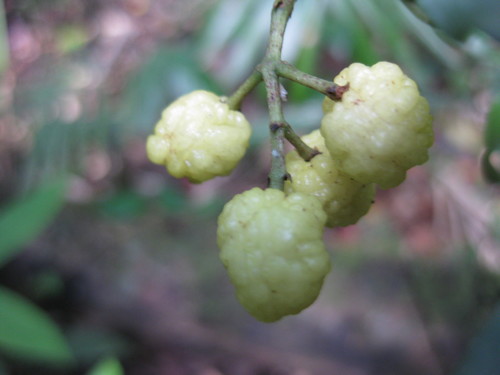
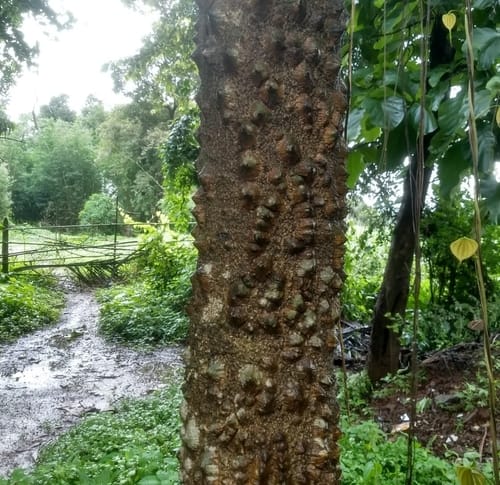
An evergreen tree. It grows 35 m tall. The trunk is long and straight. The crown is spreading. The bark is pale grey and has large stout woody prickles. It can lose its leaves during the year. These can be 2 cm long. The leaves are 15-65 cm long. They have leaflets along the stalk. There are 5-14 pairs. These are 7-18 cm long by 3-6 cm wide. The end one is the largest. They are oval and taper to the tip. The flowers are pale green. They are small and usually of one sex. They are in long stalked clusters 8-20 cm long. They fruit are 6-9 mm long. They are in clusters of up to 100 fruit. They are pale green when young but turn pink or red.
How to Grow
Prefers a good deep well-drained moisture retentive soil in full sun or semi-shade. A dioecious species, both male and female forms must be grown if seed is required.
Propagation: Seed - best sown as soon as it is ripe. Stored seed may requires up to 3 months cold stratification, though scarification may also help. Germination should take place within 6 months, though it might take another 12 months. Prick out the seedlings into individual pots when they are large enough to handle and grow them until large enough to plant out. Cuttings of half-ripe wood. Root cuttings, 3cm long, planted horizontally in pots. Good percentage. Suckers, removed when the plant is dormant, and planted direct into their permanent positions.
Medicinal Uses
The peel of the fruits, the seeds, the bark of the stems and roots as well as the oil (mullillam-oil), extracted from the fruits, are used for medicinal purposes. A decoction of the bark is taken internally as a cure for pains in the chest. The bark is pounded and mixed with oil then used externally as a remedy for stomach pains. When chewed it is applied to snakebites. The fruits are aromatic, astringent, stimulant, and stomachic. They are used in the treatment of dyspepsia, asthma and bronchitis, heart troubles, toothache and rheumatism. The skin of the fruit is credited with astringent, stimulant and digestive properties. An oil obtained by steam distillation is used as a traditional remedy for cholera. It is further applied as an antiseptic and disinfectant. The report does not say which part of the plant yields this essential oil, but it is likely to be the fruit.
Other Uses
The yellowish-grey wood is moderately hard, close-grained.
Wikipedia
Source ↗Zanthoxylum rhetsa, commonly known as Indian prickly ash, is a species of flowering plant in the family Rutaceae and occurs from India east to the Philippines and south to northern Australia. It is a deciduous shrub or tree with cone-shaped spines on the stems, pinnate leaves with between nine and twenty-three leaflets, panicles of white or yellowish, male and female flowers, followed by spherical red, brown or black follicles.
Production
In southern India plants fruit in June to September. In Sikkim in July and August.
Other Information
Leaves are sold in local markets.
Names & Synonyms
Aramaadala, Arempala, Arloso hanjor, Baharmani, Bajarmoni budrunga, Bajruli, Boketimur, Cheang, Ching-it, Chirphal, Dieng-soh-mirik, Jummina, Kadumenasu, Kothumirikku, Mai khean, Mak khaen, Mechme, Michangakoti, Mullilam, Mullilavu, Ngang, Onger esing, Petak, Petla kaayi, Singzual, Shumiccheng, Tenga nang, Tirphal, Tisal
References (28)
- A Rapid Participatory Biodiversity Assessment. 2007, Southern Lao PDR. IUCN p 105
- Chase, P. & Singh, O. P., 2016, Bioresources of Nagaland: A Case of Wild 4 Edible Fruits in Khonoma Village Forest. in J. Purkayastha (ed.), Bioprospecting of Indigenous Bioresources of North-East India. p 51
- Chandrashekara, U. M., 2009, Tree species yielding edible fruit in the coffee-based homegardens of Kerala, India: their diversity, uses and management. Food Sec. 1:361-370
- Dobriyal, M. J. R. & Dobriyal, R., 2014, Non Wood Forest Produce an Option for Ethnic Food and Nutritional Security in India. Int. J. of Usuf. Mngt. 15(1):17-37 (As Xanthoxylum)
- Dutta, U., 2012, Wild Vegetables collected by the local communities from the Churang reserve of BTD, Assam. International Journal of Science and Advanced Technology. Vol. 2(4) p 124
- Ethnobotany of Karbis. Chapter 4 in p 102
- Gardner, S., et al, 2000, A Field Guide to Forest Trees of Northern Thailand, Kobfai Publishing Project. p 105 (rhetsa)
- Guite, C., 2016, Study of wild edible plants associated with the Paite Tribe of Manipur, India. International Journal of Current Research. Vol. 8, Issue 11, pp. 40927-40932
- Kar, A., et al, 2013, Wild Edible Plant Resources used by the Mizos of Mizoram, India. Kathmandu University Journal of Science, Engineering and Technology. Vol. 9, No. 1, July, 2013, 106-126
- Kumar, A., et al, 2012, Ethnobotanical Edible Plant Biodiversity of Lepcha Tribes. Indian Forester, 138 (9):798-803
- Luczaj, L., et al, 2021, Wild food plants and fungi sold in the markets of Luang Prabang, Lao PDR. Journal of Ethnobiology and Ethnomedicine (2021) 17:6
- Mahadkar, S., Valvi, S. & Rathod, V., 2012, Nutritional assessment of some selected wild edible plants as a good source of mineral. Asian Journal of Plant Science and Research 2(4):468-472
- Manju, S., and Sundriyal, R. C., 2001, Wild Edible Plants of the Sikkim Himalaya: Nutritive Values of Selected Species. Economic Botany 55(3): 377-390 (As rhetuza)
- Martin, F. W., et al, 1987, Perennial Edible Fruits of the Tropics. USDA Handbook 642 p 78
- Meitei, L. R., et al, 2022, An ethnobotanical study on the wild edible plants used by forest dwellers in Yangoupokpi Lokchao Wildlife Sanctuary, Manipur, India. Ethnobotany Research and Application 23:15
- Murtem, G. & Chaudhrey, P., 2016, An ethnobotanical note on wild edible plants of Upper Eastern Himalaya, India. Brazilian Journal of Biological Sciences, 2016, v. 3, no. 5, p. 63-81.
- Patiri, B. & Borah, A., 2007, Wild Edible Plants of Assam. Geethaki Publishers. p 23
- Pegu, R., et al, 2013, Ethnobotanical study of Wild Edible Plants in Poba Reserved Forest, Assam, India. Research Journal of Agriculture and Forestry Sciences 1(3):1-10
- Peter, K. V. (Ed.), 2004, Handbook of Herbs and Spices Vol. 2 Woodhead Publishing and CRC Press.
- Pradheep, K., et al, 2016, Wild edible plants used by Konyak tribe in Mon district of Nagaland: Survey and inventorisation. Indian Journal of Natural Products and Resources. Vol 7(1) pp 74-81 (As Zanthoxylum rhetsum)
- Ravikrishna, S., 2011, Ethno-medico-botanical survey on Wild Edible fruits of Udupi Taluq, Udupi p 113
- Sawian, J. T., et al, 2007, Wild edible plants of Meghalaya, North-east India. Natural Product Radiance Vol. 6(5): p 423
- Singh, B., et al, 2012, Wild edible plants used by Garo tribes of Nokrek Biosphere Reserve in Meghalaya, India. Indian Journal of Traditional Knowledge. 11(1) pp 166-171
- Sundriyal, M., et al, 2004, Dietary Use of Wild Plant Resources in the Sikkim Himalaya, India. Economic Botany 58(4) pp 626-638
- Teron, R. & Borthakur, S. K., 2016, Edible Medicines: An Exploration of Medicinal Plants in Dietary Practices of Karbi Tribal Population of Assam, Northeast India. In Mondal, N. & Sen, J.(Ed.) Nutrition and Health among tribal populations of India. p 155
- Tsering, J., et al, 2017, Ethnobotanical appraisal on wild edible plants used by the Monpa community of Arunchal Pradesh. Indian Journal of Traditional Knowledge. Vol 16(4), October 2017, pp 626-637
- Wiersema, J. H. & Leon, B., 2013, World Economic Plants. A Standard Reference CRC Press. 2nd Ed. p 733
- World Checklist of Useful Plant Species 2020. Royal Botanic Gardens, Kew