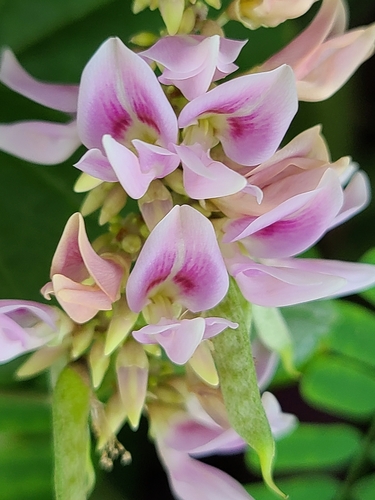
Butea monosperma
(Lam.) Taub.
Flame of the Forest

(c) Vijay Barve, some rights reserved (CC BY), uploaded by Vijay Barve

(c) P Jeganathan, some rights reserved (CC BY), uploaded by P Jeganathan
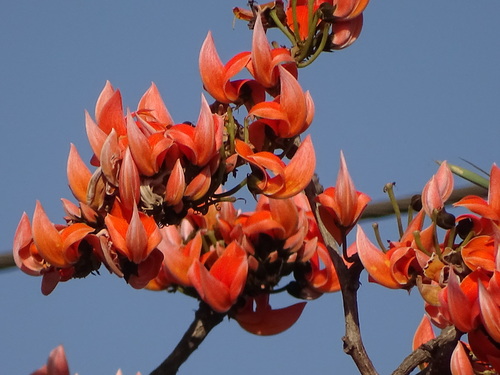
(c) Rujuta Vinod, some rights reserved (CC BY-NC), uploaded by Rujuta Vinod
What to Eat
Edible parts: Roots, Flowers, Gum, Leaves, Pods
The plant is used to make timber, resin, fodder, medicine, and dye. The wood is dirty white and soft. Being durable under water, it is used for well curbs and water scoops. Spoons and ladles made of its wood are used in various Hindu rituals to pour ghee into the fire. Good charcoal can be obtained from it. Farmers typically plant trees on field bunds and use them to reduce soil erosion. Young shoots are grazed by buffaloes as fodder. The leaves were once used to serve food where plastic plates would be used today. Consumption of Palash Sharbat (a drink made with the plant) is noted in Ayurvedic traditions to help the body endure heat and may support general health. Some modern studies have highlighted its antioxidant content, but robust clinical evidence is currently limited. Fixed oil in the seed and glucoside butrin of the flower sap are considered to be poisonous. Its consumption may cause dizziness, headache, and hypotension. The gum from the tree, called kamarkas in Hindi, is used in certain food dishes. In Maharashtra state of India it is prepared as a summer beverage out of tea of the flower which is considered to have medicinal benefits.
Where to Find It
A tropical plant. It is native to India, Burma and Sri Lanka. They are frost tender. It grows in the Himalayas up to 1,220 m altitude. It can grow on gravels or plains soils. It needs a well-drained soil. It needs full sun. It can tolerate some soil salinity. It suits hardiness zones 11-12. In Yunnan.
Asia, Australia, Bhutan, Cambodia, China, Himalayas, India, Indochina, Indonesia, Laos, Malaysia, Myanmar, Nepal, Northeastern India, Pacific, Pakistan, Papua New Guinea, PNG, SE Asia, Sri Lanka, Thailand, Vietnam,
How to Identify
A strongly branched tree. It has an irregular trunk. It becomes twisted with age. It grows 8 to 15 m high and spreads to 3-5 m wide. The cut bark yields a red gum. The leaves are leathery but with a silky back. They consist of 3 diamond shaped leaflets. These are 10-20 cm long by 4-20 cm wide and on stalks almost as long. The flowers are on equal length stalks around a common axis. These are 15 cm long and have rich red flowers with silver hairs. The flowers are 3-4 cm long. The flower stalks appear along the bare branches. The fruit is oblong and 10-20 cm long by 3-6 cm wide. They are flat, thin pods with silvery hairs. The seed are produced towards the top end of the pod. The seeds are 3.5 cm long by 2.5 cm wide and very flattened.
How to Grow
Plants are grown from seed. They should be planted as soon as they ripen. The seedlings can be transplanted after 2-3 years.
Propagation: Seed - sow in situ. Germination, which starts in about 10 - 12 days, is completed in 4 weeks. Fresh seeds have a good germinative capacity (about 63%) at optimum germination temperature of about 30°c. While germinating in the wild, the seed remains in the pod which opens at the tip and allows the young shoot and root to emerge. The cotyledons remain attached to the seedling for a considerable time. Root suckers. Air layering.
Medicinal Uses
Butea gum, or Bengal kino, an exudate from the tannin-rich vesicles in the bark, is used medicinally. A powerful astringent, it is used in the treatment of diarrhoea and wounds. The seeds, ground into a paste with honey, are used for their anthelmintic, antifungal, antibacterial and purgative properties. The seed paste, mixed with lemon juice, are used as a rubefacient The seeds contain around 18% oil. Called 'moodoga oil', it is an effective treatment for hookworms. The flowers and leaves are aphrodisiac, astringent and diuretic. The flowers are useful in the treatment of liver disorders The flowers contain butrin and isobutrin. These compounds have been shown to have antihepatotoxic principles. The seeds act as an anthelmintic. A potential anti-asthmatic agent has been reported from the bark
Other Uses
The flowers are used for the preparation of a yellow dye (for silk especially, also ritually used). A bright yellow to deep orange-red dye, known as butein, can be prepared from the flowers. It is used especially for dyeing silk and sometimes for cotton, and is traditionally used by Hindus to mark the forehead. The colour is, however, fleeting, but it may be made less so by using alum or lime as a mordant, which also deepens the colour. Sometimes myrabolans are used for this purpose, or the dye is combined with anatta (Bixa orellana). A red dye is obtained from the roots. The bark is a source of tannins. A red exudate is obtained from the tannin-rich vesicles in the bark. It hardens into a gum, known as Butea gum, or Bengal kino and can be used medicinally, as a dye or for tannin. It occurs in the form of round tears, often fragmentary. It may be purified by solution in water. It is of a brilliant ruby-red colour, translucent and brittle, heat rendering it more so instead of melting it. A small quantity of a bright, clear oil is obtained from the seeds. The seeds contain up to 18% oil. A coarse, tough, fibrous material, known as 'pala fibre' is obtained from the inner bark. It is used for cordage, caulking the seams of boats and making paper. A strong fibre, obtained from the roots, is used in India for making native sandals, ropes etc. The soft and not durable wood is light, white or yellowish-brown when fresh, but often turning greyish because of susceptibility to sap stain. It is not of great value but is sometimes used for utensils. The wood is durable under water and is used to make well curbs, water dippers, sacred utensils etc. The wood makes a fuel of moderate quality. The leaves are sometimes used as a fuel. The wood is burnt for gunpowder charcoal. Seedlings and green branches are spread in rice fields as a salt-filtering agent and green manure. Leaf-decomposing bacteria produce a slime that is able to aggregate clay particles. In the course of this process micro-cavities are formed loosening the compacted soil and allowing leaching of noxious salts from the soil solution. In India, farmers frequently use this tree to stabilize field bunds.
Wikipedia
Source ↗Butea monosperma is a species of Butea native to tropical and sub-tropical parts of South Asia and Southeast Asia. It is also known as flame of the forest, Bengal kino, dhak, palash, and bastard teak. Revered as sacred by Hindus, it is prized for producing an abundance of vivid blooms, and it is also cultivated elsewhere as an ornamental. The plant grows across Bangladesh, India, Nepal, Pakistan, Sri Lanka, Myanmar, Thailand, Laos, Cambodia, Vietnam, Malaysia, and western Indonesia.
Production
The tree is slow growing.
Other Information
It is not known if they are used as food in Papua New Guinea.
Notes
There are 2-4 Butea species. The leaf is used as a plate for serving food.
Names & Synonyms
Bastard Tree, Bengal kino, Chan mot hot, Char, Charr, Chhar, Dangs, Dhak, Gienggieng, Khakhar, Moduga, Morud, Mutthuga, Muttuga, Palas in samatha, Palas, Palasa, Palash, Palasha, Parasa, Parsa, Plah, Ploso, Pohon api-api hutan, Pohon palasa, Polash, Thawng-kwaao, Thong-gwao
References (32)
- Ambasta S.P. (Ed.), 2000, The Useful Plants of India. CSIR India. p 91
- Bandyopadhyay, S. et al, 2009, Wild edible plants of Koch Bihar district, West Bengal. Natural Products Radiance 8(1) 64-72
- Barwick, M., 2004, Tropical and Subtropical Trees. A Worldwide Encyclopedic Guide. Thames and Hudson p 73
- Bole, P.V., & Yaghani, Y., 1985, Field Guide to the Common Trees of India. OUP p 45
- Brickell, C. (Ed.), 1999, The Royal Horticultural Society A-Z Encyclopedia of Garden Plants. Convent Garden Books. p 198
- Burkill, I.H., 1966, A Dictionary of the Economic Products of the Malay Peninsula. Ministry of Agriculture and Cooperatives, Kuala Lumpur, Malaysia. Vol 1 (A-H) p 388
- Cengel, D. J. & Dany, C., (Eds), 2016, Integrating Forest Biodiversity Resource Management and Sustainable Community Livelihood Development in the Preah Vihear Protected Forest. International Tropical Timber Organization p 119
- Chandrakumar, P., et al, 2015, Ethnobotanical studies of wild edible plants of Gond, Halba and Kawar tribes of Salekasa Taluka, Gondia District, Maharashtra State, India. International Research Journal of Pharmacy 6(8)
- Dey, A. & Mukhererjee, A., 2015, Living and Survival Amidst Hunger: Wild Edible Botanicals as a Prime Forest Productivity in the Rural Purulia District, West Bengal, India from Colonial to Present. Research Journal of Forestry 9(3): 71-86
- Engel, D.H., & Phummai, S., 2000, A Field Guide to Tropical Plants of Asia. Timber Press. p 29
- H. G. A. Engler & K. A. E. Prantl, Nat. Pflanzenfam. 3(3):366. 1894
- GAMMIE, (As Butea frondosa)
- GUPTA & KANODIA,
- Krishen P., 2006, Trees of Delhi, A Field Guide. DK Books. p 192
- Lim, T. K., 2015, Edible Medicinal and Non Medicinal Plants. Volume 9, Modified Stems, Roots, Bulbs. Springer p 19
- Llamas, K.A., 2003, Tropical Flowering Plants. Timber Press. p 216
- Lord, E.E., & Willis, J.H., 1999, Shrubs and Trees for Australian gardens. Lothian. p 49 (As Butea frondosa)
- McMakin, P.D., 2000, Flowering Plants of Thailand. A Field Guide. White Lotus. p 19
- Mishra, S. & Chaudhury, S. S., 2012, Ethnobotanical flora used by four major tribes of Koraput, Odisha, India. Genetic Resources Crop Evolution 59:793-804
- Phon, P., 2000, Plants used in Cambodia. © Pauline Dy Phon, Phnom Penh, Cambodia. p 108
- Prashanth Kumar, G.M. and Shiddamallayya, N., 2015, Ethnobotanical Study of Less Known Wild Edible Plants of Hakki Pikki Tribes of Angadihalli, Hassan District, Karnataka. Journal or Medicinal Plants Studies 3(5):80-85
- Sahni, K.C., 2000, The Book of Indian Trees. Bombay Natural History Society. Oxford. p 87
- Sarma, H., et al, 2010, Updated Estimates of Wild Edible and Threatened Plants of Assam: A Meta-analysis. International Journal of Botany 6(4): 414-423
- SAXENA;
- SHANKARNARAYAN & SAXENA.
- Singh, G. K. & Ahirwar, R. K., 2013, An Ethnobotanical Survey for Certain Wild Edible Plants of Chanda Forest District Dindori Central India. International Journal of Science and Research. 6:14
- Sukarya, D. G., (Ed.) 2013, 3,500 Plant Species of the Botanic Gardens of Indonesia. LIPI p 167
- Swaminathan, M.S., and Kochnar, S.L., 2007, An Atlas of Major Flowering Trees in India. Macmillan. p 103
- Verdcourt, B., 1979, Manual of New Guinea Legumes. Botany Bulletin No 11, Division of Botany, Lae, Papua New Guinea. p 463
- WATT, 1908, (As Butea frondosa)
- Wild edible plants of Himachal Pradesh
- World Checklist of Useful Plant Species 2020. Royal Botanic Gardens, Kew