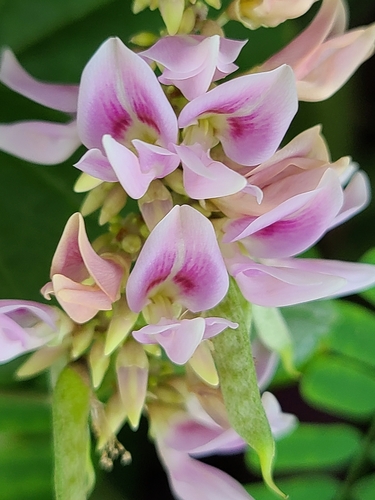
Centrolobium ochroxylum
Tul.
Amarillo

(c) galilea_orellana, some rights reserved (CC BY-NC)

(c) Ángel David Flores Santamaría, some rights reserved (CC BY-NC)

(c) Raúl A. Ruiz M., some rights reserved (CC BY)
What to Eat
Edible parts: Seeds
Its wood is highly sought after in the local market for carpentry. It is also used locally for rural constructions, firewood, and its fruit serves as food for birds and squirrels.
Where to Find It
It is a tropical plant.
Ecuador, South America,
How to Identify
A tree.
Other Uses
The wood of the various species of Centrolobium is richly coloured, usually yellowish or orange, with streaks of red, purple, or black, and takes a high satiny finish. It is of value for furniture, flooring, cooperage, shipbuilding, railway ties, mine timbers, and general construction..
Wikipedia
Source ↗Centrolobium ochroxylum is a species of legume. It was first described by Velva Elaine Rudd. Centrolobium ochroxylum is part of the genus Centrolobium, and the family Fabaceae. Centrolobium ochroxylum is an evergreen tree of medium to tall stature, capable of reaching up to 30 meters in height. It has a straight base and a globose crown. Its outer bark is light brown. Its branches have dense dark pubescence, pubescent petioles, and alternate, imparipinnately compound leaves. The petiolules are short, less than 3 to 5 mm, with 9 to 11 leaflets, each 9 to 19 cm long and 7 to 12 cm wide. The leaflets are opposite in a single plane, with the blade broadly elliptic to nearly round, an entire margin, an acuminate apex, and a rounded to obtuse base on the terminal leaflet.
References (2)
- Torre, de la, L., et al, 2008, Enciclopedia de las Plantas Útiles del Ecuador. Herbario QCA. Pontificia Universidad Católica del Ecuador. p 336
- Van den Eynden, V., et al, 2003, Wild Foods from South Ecuador. Economic Botany 57(4): 576-603