Inga striata
Benth.
Striate inga
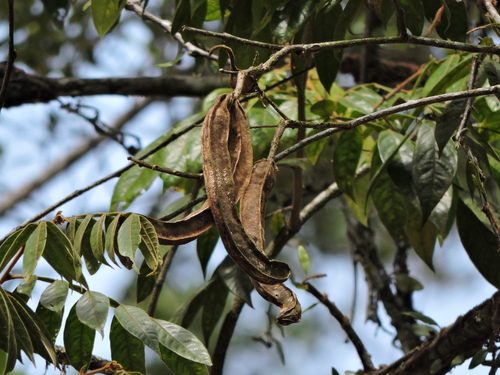
(c) Fabrício Mil Homens Riella, some rights reserved (CC BY), uploaded by Fabrício Mil Homens Riella

(c) Geovane Siqueira, some rights reserved (CC BY-NC), uploaded by Geovane Siqueira

(c) Geovane Siqueira, some rights reserved (CC BY-NC), uploaded by Geovane Siqueira
What to Eat
Edible parts: Fruit - aril, Pod pulp
The aril or fleshy layer surrounding the seeds is eaten raw, and the pod pulp is also consumed.
Where to Find It
It is a tropical plant.
Amazon, Andes, Bolivia, Brazil, Colombia, Ecuador, Guiana, Peru, South America,
How to Identify
A tropical tree that produces long seed pods. It grows easily from fresh seeds, which germinate in 1-2 weeks under moisture and shade, and is widely cultivated.
How to Grow
Plants grow easily from fresh seeds. Seeds germinate in 1-2 weeks given moisture and shade.
Other Uses
The wood of Inga species is generally attractive, but it has a coarse texture, is susceptible to attack by dry-wood termites and is not durable in the soil. When grown as a shade tree, the plant is pruned on a regular basis, and these prunings are often burned as a fuel. The plant is widely grown to provide shade for coffee trees in Brazil. Inga species generally have a number of factors that make them popular for use as shade trees in coffee and cacao plantations:- they grow quickly and so soon make an effecte shade; they respond well to drastic pruning and so are easy to keep within the required size and shade levels; they promote and maintain soil fertility; they are effective soil stabilizers.
Wikipedia
Source ↗Inga striata is a perennial tree species and is a member of the family Fabaceae. This species occurs in countries like Bolivia, Brazil, Colombia, Ecuador, Guyana, Peru, Suriname and the territory of French Guiana. It is uncertain if it occurs in Venezuela. Trees can grow up to 20 m. Inga striata have less stomatal conductance and transpiration in soil polluted with clomazone.
Other Information
It is cultivated.
Notes
Also as Mimosaceae.
Names & Synonyms
Guaba de cajon, GUaba de mono, Guaba musga, Guaba verde, Guabo amarillo, Inga banana, Ingazeiro, Pacay, Pakay
References (9)
- Bortolotto, I. M., et al, 2018, Lista preliminar das plantas alimenticias nativas de Mato Grosso do Sul, Brasil. Iheringia, Serie Botanica, Porto Alegre, 73 (supl.):101-116
- Grandtner, M. M. & Chevrette, J., 2013, Dictionary of Trees, Volume 2: South America: Nomenclature, Taxonomy and Ecology. Academic Press p 326
- Kermath, B. M., et al, 2014, Food Plants in the Americas: A survey of the domesticated, cultivated and wild plants used for Human food in North, Central and South America and the Caribbean. On line draft. p 446
- Roa, J. A. G. & Boada, D. S. G., 2018, Fundación para el Fortalecimiento de la Fruticultura y Plantas Alimenticias no Convencionales en Colombia.
- Torre, de la, L., et al, 2008, Enciclopedia de las Plantas Útiles del Ecuador. Herbario QCA. Pontificia Universidad Católica del Ecuador. p 347
- Van den Eynden, V., et al, 2003, Wild Foods from South Ecuador. Economic Botany 57(4): 576-603
- Van den Eynden, V., 2004, Use and management of edible non-crop plants in southern Ecuador, Ph D dissertation. p 108
- Van den Eynden, V., et al, 2004, Regional and ecological variations of wild edible plants in southern Ecuador. Lyonia. 7(2)
- www.colecionandofrutas.org




