Rubus azuayensis
Romoleroux
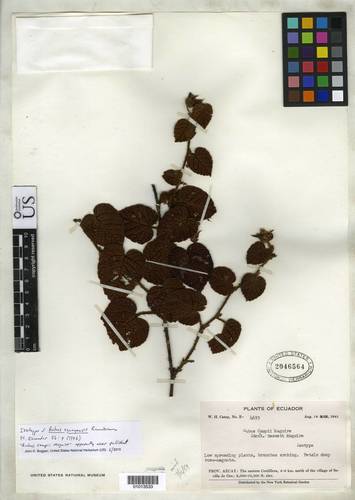
(c) Smithsonian Institution, National Museum of Natural History, Department of Botany, some rights reserved (CC BY-NC-SA)
What to Eat
Edible parts: Fruit
The fruit are eaten raw or used to make marmalade.
Dangerous Lookalikes
This plant can be confused with the following toxic species. Always verify identification carefully before consuming any wild plant.


Red Baneberry: Short herbaceous plant (no thorns), berries on thick red stems, each berry has a single seed, compound sharply-toothed leaves.
Rubus azuayensis: Thorny woody canes (brambles), aggregate berry made of many drupelets, berries pull easily from receptacle.
Where to Find It
It is a tropical plant. It grows in the humid western Andes at about 2,800 m above sea level.
Ecuador*, South America,
How to Identify
A creeping herb in the Rosaceae family found in the tropical humid western Andes at approximately 2,800 m elevation.
Wikipedia
Source ↗Rubus azuayensis is a species of plant in the family Rosaceae. It is endemic to Ecuador.
Names & Synonyms
Mora
References (3)
- Torre, de la, L., et al, 2008, Enciclopedia de las Plantas Útiles del Ecuador. Herbario QCA. Pontificia Universidad Católica del Ecuador. p 537
- Van den Eynden, V., et al, 2003, Wild Foods from South Ecuador. Economic Botany 57(4): 576-603
- Van den Eynden, V., 2004, Use and Management of edible non-crop plants in southern Ecuador. Ph. D. dissertation Faculty of Agricultural and Applied Biological Sciences, Belgium, 246pp
More from Rosaceae


