Cyclea barbata
Miers
Cincau leaves
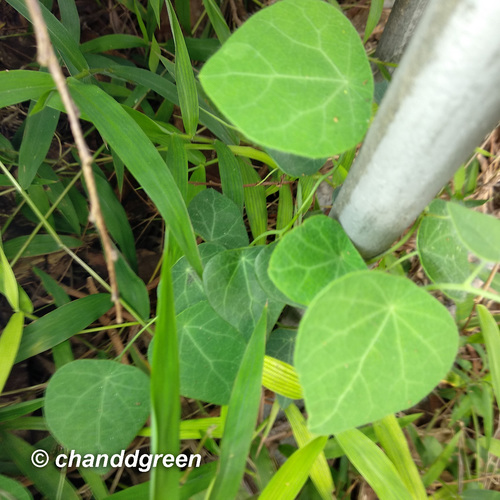
(c) Young Chan, some rights reserved (CC BY-NC), uploaded by Young Chan
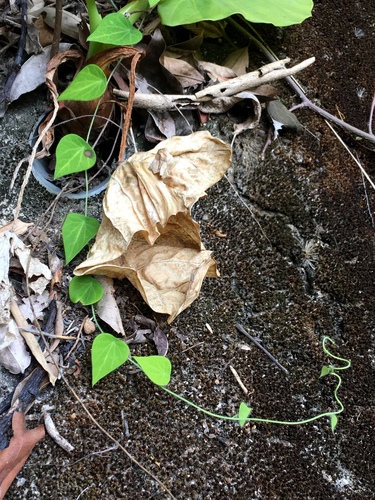
(c) Yj, some rights reserved (CC BY)
What to Eat
Edible parts: Leaves, Root
The leaves are used in Java to prepare a jelly called 'cincau' or 'cincau hijau' (green cincau), which is used as a refreshment and as a medicine against stomach complaints. The leaves are crushed in water and the mixture left to set. It is usually eaten with a sweet syrup. To make a good quality jelly only young well-developed leaves should be used. The shelf-life of the jelly at ambient temperature is around 1 - 2 days..
Where to Find It
It is a tropical plant. It grows on the edges of forests and in shrubland. It grows up to 1,100 m above sea level.
Asia, Cambodia, China, India, Indochina, Indonesia, Laos, Myanmar, SE Asia, Thailand, Vietnam,
How to Identify
A slender climber or vine. It grows 5 m high. The roots are fleshy. The leaves are oval to triangle shaped. The leaf stalk joins the blade away from the edge. The leaves are 4-10 cm long by 3-8 cm wide. The fruit are fleshy and red.
How to Grow
Plants can be grown from seeds.
Medicinal Uses
A decoction made of the roots is used in local medicine against fever. The very bitter taste is due to the alkaloid 'cycleine'. The roots have a high content of starch and around 10% fat. The leaves are used in Java to prepare a jelly called 'cincau' or 'cincau hijau' (green cincau), which is used as a refreshment and also as a medicine against stomach complaints.
Wikipedia
Source ↗Cyclea barbata is a species of flowering plants that was commonly used as a medicinal plant in Java. It is also used to produce Indonesian typical green grass jelly.
Names & Synonyms
Cincau rambat, Mo noy, Sam nam, Vor phraskrong
References (7)
- Delang, C. O., 2007, Ecological Succession of Usable Plants in an Eleven-Year Fallow Cycle in North Lao P.D.R., Ethnobotany Research and Applications. Vol. 5:331-350
- Forman, 1984, Menispermaceae, Flora Malesiana Series 1 Vol 10 p 242
- Luczaj, L., et al, 2021, Wild food plants and fungi sold in the markets of Luang Prabang, Lao PDR. Journal of Ethnobiology and Ethnomedicine (2021) 17:6
- Sang, D. T., & Mizoue, K. O. N., 2012, Use of Edible Forest Plants among Indigenous Ethnic Minorities in Cat Tien Biosphere Reserve, Vietnam. Asian Journal of Biodiversity Vol. 3 (1), p 23-49
- Sukarya, D. G., (Ed.) 2013, 3,500 Plant Species of the Botanic Gardens of Indonesia. LIPI p 916
- Turreira Garcia, N., et al, 2017, Ethnobotanical knowledgeof the Kuy and Khmer people in Prey Lang, Cambodia. Cambodian Journal of Natural History 2017 (1): 76-101
- World Checklist of Useful Plant Species 2020. Royal Botanic Gardens, Kew


