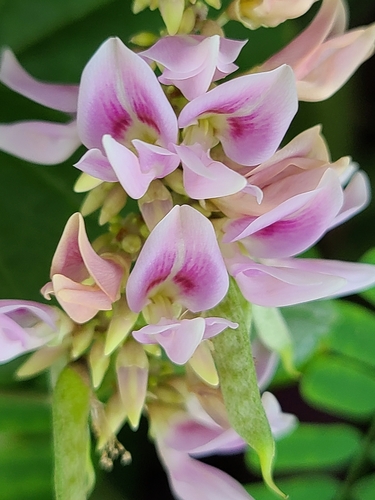
Craibia brownii
Dunn

MBG

Royal Botanic Gardens, Kew

MBG
What to Eat
Edible parts: Seeds
The seeds are eaten after long cooking.
Known Hazards
Where to Find It
It is a tropical plant. It grows in dry and moist forest and along rivers. It grows between 1,100-2,200 m altitude. It is in areas with a rainfall of 850-1,400 mm per year.
Africa, Central Africa, Congo, East Africa, Kenya, Tanzania, Uganda, Zambia,
How to Identify
A medium sized tree. It grows 24 m tall. The bark is pale grey. The leaves are alternate. The leaves are compound with leaflets along the stalk and one at the end. There are 3-9 leaflets. The leaf stalk is about 2 cm long. The leaves are about 12 cm long. The leaflets are 4-15 cm long by 2-7 cm wide. They have a wedge shaped base and taper to the tip. The flowers contain both sexes. They can be blue, pink or white. The fruit are on short stalks. They are flat pods 5-10 cm long and 2-4 cm wide. The pod is unequal and open with the sides twisting. There are 2-3 seeds. The seeds are 17 mm long and 15 mm wide.
How to Grow
A plant of the drier to moist tropics, it is found wild in areas where the mean annual rainfall is within the range 850 - 1,400mm A slow-growing tree. The tree is exceptionally beautiful when in bloom - its strongly scented, creamy-white flowers being conspicuous against the light green foliage.
Other Uses
The whitish wood is hard, with a fine texture. It is used for building poles, tool handles and wooden spoons. The wood is used for fuel and to make charcoal.
Notes
There are 10 Craibia species. They grow in tropical Africa.
Names & Synonyms
References (3)
- Brink, M., 2006. Craibia brownii Dunn. [Internet] Record from Protabase. Brink, M. & Belay, G. (Editors). PROTA (Plant Resources of Tropical Africa), Wageningen, Netherlands. < http://database.prota.org/search.htm>. Accessed 15 October 2009.
- Mutie, F. M., et al, 2023, Important Medicinal and Food Taxa (Orders and Families) in Kenya, Based on Three Quantitative Approaches. Plants 2023, 12, 1145
- World Checklist of Useful Plant Species 2020. Royal Botanic Gardens, Kew