Pentaclethra eetveldeana
De Wild & T. Durand

Saint Fédriche NDZAI

Saint Fédriche NDZAI

Saint Fédriche NDZAI
What to Eat
Edible parts: Seeds - oil, Seeds
The seeds are eaten roasted or crushed, and can also be processed for oil.
Known Hazards
Where to Find It
It is a tropical plant. It grows in rainforest and in secondary forest. It suits humid locations.
Africa, Cabinda, Cameroon, Central Africa, Congo DR, Congo R, Equatorial Guinea, Gabon,
How to Identify
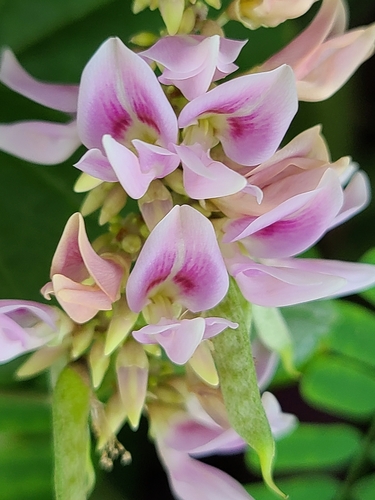
A medium sized tree. It grows 30 m tall. The trunk is 50 cm across. It has small buttresses. The bark is grey and fissured. The crown is dome shaped. The young branches are hairy. The leaves are alternate and compound. They are twice divided with leaflets along the stalk. The leaves are 40 cm long. There are 9-16 pairs of opposite leaflet bearing stalks. These are 4-12 cm long. They have 15-30 pairs of leaflets. The leaflets are 8-13 mm long by 2-3 mm wide. The flowers are in a group in the axils of leaves or at the ends of branches. These can be 30 cm long with many flowers. The fruit is a long pod 20 cm long by 4 cm wide. It is reddish brown and has a stripe along it. It opens explosively on the tree then curves backwards. There are 3-8 seeds. They are oval and flattened. They are 2-3 cm long by 2-2.5 cm wide. They are smooth and reddish-brown.
How to Grow
Plants are grown from seed. It is best to plant the seeds directly in the field and this avoids damaging the taproot.
Propagation: Seed - the germination rate is generally high, but germination is often unevenly distributed. It is recommended that the seeds be planted directly into the field because the taproot of the seedlings is easily damaged in transplanting.
Medicinal Uses
A leaf decoction is taken to treat stomach-ache and colds. The root bark is used to treat malaria, epilepsy and haemorrhoids. A bark decoction is administered to treat respiratory troubles, tuberculosis, genito-urinary complaints and as an anthelmintic. It is applied externally against rheumatism and as an anodyne. Bark extracts have shown antifungal activity. Some monoglycerides and fatty acid conjugates of triterpenes were isolated from the root bark. Bark sap is administered as eye drops to treat filariasis.
Other Uses
An oil obtained from the seed is used in soap and candle production. The heartwood is pinkish white or yellowish white to dark brown, and distinctly demarcated from the up to 25mm thick white to pale yellow sapwood. The grain is straight; texture medium to coarse; dark-coloured veins may be visible on the radial surface of the wood, whereas the tangential surface is slightly striped. The wood is moderately heavy; fairly hard; moderately durable, being susceptible to pinhole borer and marine borer attacks and moderately resistant to termites. It finishes satisfactorily; sawing does not cause great difficulties as long as speeds are slow; it does not split in nailing and holds nails well. The wood is used for construction and implements (e.g. Pestles and mortars). It is also suitable for flooring, interior trim, joinery, furniture, cabinet work, toys and novelties, mine props, vehicle bodies, railway sleepers, turnery, veneer, plywood, hardboard and particle board. The wood is commonly used as firewood and for charcoal production. The tree regenerates well in disturbed soils, fixes atmospheric nitrogen and grows fairly quickly. It is probably suitable for use as a pioneer species.
Notes
There are 3 Pentaclethra species. Also as Mimosaceae.
Names & Synonyms
Kiseka, Nsambu, Nseka, Nseka mfusila, Nsombo neska
References (3)
- Latham, P., 2004, Useful Plants of Bas-Congo province. Salvation Army & DFID p 215
- Lemmens, R.H.M.J., 2007. Pentaclethra eetveldeana De Wild. & T.Durand. [Internet] Record from Protabase. van der Vossen, H.A.M. & Mkamilo, G.S. (Editors). PROTA (Plant Resources of Tropical Africa), Wageningen, Netherlands. < http://database.prota.org/search.htm>. Accessed 20 October 200919 October 2009.
- Nkeoua, G. & Boundzanga, G. C., 1999, Donnees sur les produits forestieres non ligneux en Republique du Congo. FAO. p 33