Malus kirghisorum
Al.Fed & An.Fed
Kirghiz apple, Kyrgyz apple
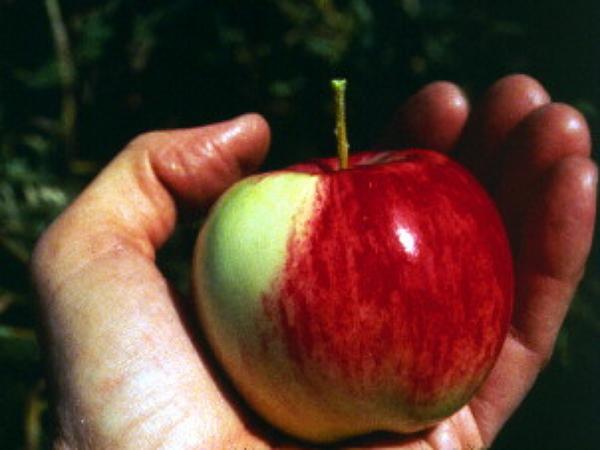
Wikimedia Commons - Agricultural Research Service (Research agent of United States Department of Agriculture)

Wikimedia Commons - Krzysztof Ziarnek, Kenraiz

Wikimedia Commons - https://ru.wikipedia.org/wiki/%D0%A3%D1%87%D0%B0%D1%81%D1%82%D0%BD%D0%B8%D0%BA:Shirius
What to Eat
Edible parts: Fruit
The fruit is eaten fresh, made into cider, stewed, used for juice, or dried.
Where to Find It
It is a temperate plant. It grows in Kazakhstan between 1,200-1,800 m above sea level. It grows in deep forest soils. It is frost resistant.
Asia, Central Asia, Kazakhstan, Kyrgyzstan,
How to Identify
A tree. It grows 10 m tall. The bark is dark grey. The crown is broad and umbrella shaped. The shoots are long and thin and do not have spines. The leaves are papery and 5-10 cm long by 3-6 cm wide. They are broadly sword shaped and taper to the base. There are a few hairs underneath. The flowers are large and 3-5 cm across and pale pink. The fruit vary in size, shape, colour and flavour. The fruit occur singly and are 3-8 cm across. The skin can be yellow, green or red.
Other Information
It is cultivated.
Names & Synonyms
References (4)
- Arora, R. K., 2014, Diversity in Underutilized Plant Species - An Asia-Pacific Perspective. Bioversity International. p 75
- Dzhangaliev, A. D., et al, 2003, The Wild Fruit and Nut Plants of Kazakhstan, Horticultural Reviews, Vol. 29. pp 305-371
- Volk, G. M. et al, 2009, Novel Diversity Identified in a Wild Apple Population from the Kyrgyz Republic. HortScience 44(2):516-518
- Zeven, A. C. & de West, J. M. J., 1982, Dictionary of cultivated plants and their regions of diversity. Wageningen. p 85
More from Rosaceae


