Sorbus persica
Hedl.
Persian mountain ash
RosaceaeFruit

iNaturalist · cc-by-nc
(c) Aleksandr Ebel, some rights reserved (CC BY-NC)
(c) Aleksandr Ebel, some rights reserved (CC BY-NC)

iNaturalist · cc-by-nc
(c) Aleksandr Ebel, some rights reserved (CC BY-NC)
(c) Aleksandr Ebel, some rights reserved (CC BY-NC)
iNaturalist · cc-by-nc
(c) Aleksandr Naumenko, some rights reserved (CC BY-NC)
(c) Aleksandr Naumenko, some rights reserved (CC BY-NC)
What to Eat
Edible parts: Fruit
The small oval fruits are edible.
Where to Find It
It is a temperate plant. In Kazakhstan it is an understory plant in mountain forest. It needs reasonable soil moisture.
Asia, Central Asia, Kazakhstan, Kyrgyzstan,
Countries: United Arab Emirates, Afghanistan, Armenia, Azerbaijan, Bangladesh, Bahrain, Brunei, Bhutan, China, Georgia, Indonesia, Israel, India, Iraq, Iran, Jordan, Japan, Kyrgyzstan, Cambodia, North Korea, South Korea, Kuwait, Kazakhstan, Laos, Lebanon, Sri Lanka, Myanmar, Mongolia, Maldives, Malaysia, Nepal, Oman, Philippines, Pakistan, Qatar, Saudi Arabia, Singapore, Syria, Thailand, Tajikistan, Timor-Leste, Turkmenistan, Turkey, Taiwan, Uzbekistan, Vietnam, Yemen
How to Identify
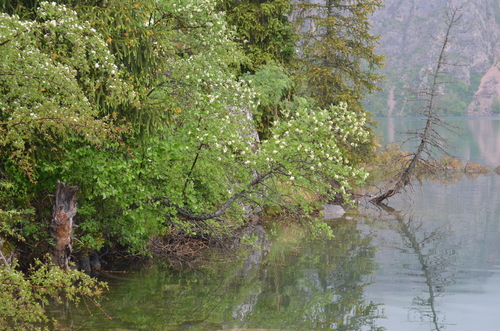
A tree. It grows 2-5 m tall. The crown is broad and open. Young shoots are very hairy. The leaves are simple and have lobes. They are 5-10 cm long by 5-6 cm wide. The leaves are bright green on top and silvery grey underneath. The flowers are in compact groups of 20-22. These are 9 cm across. The flower stalks are very hairy. The fruit are small and broadly oval. They are edible.
Production
A fruit weighs 1.3 g.
References (1)
- Dzhangaliev, A. D., et al, 2003, The Wild Fruit and Nut Plants of Kazakhstan, Horticultural Reviews, Vol. 29. pp 305-371
More from Rosaceae

Acaena anserinifolia
Bidgee widgee, Buzzy, New Zealand Bur
No photo
Acaenia anserinifolia - (J.R.Forst.&G.Forst.)Druce.
Pirri-Pirri Bur

Adenostoma sparsifolium
Red shanks, Ribbonwood

Agrimonia eupatoria
Agrimony, Salt and Pepper

Agrimonia odorata
Adour agrimony, Liver-wort

Agrimonia pilosa
Indian chestnut, Agrimony