Prunus spinosissima
(Bunge) Franch.
Thorny almond
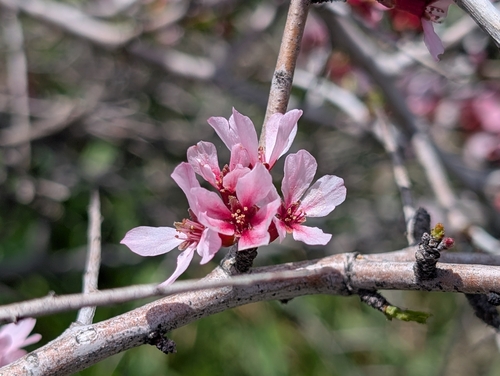
(c) Todd Boland, some rights reserved (CC BY-NC), uploaded by Todd Boland
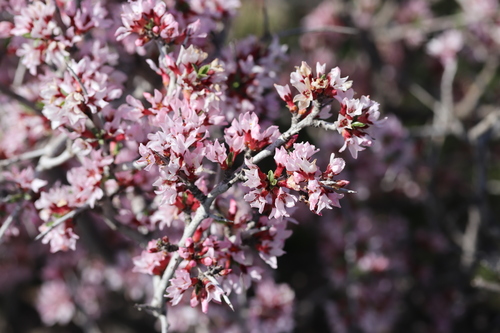
(c) Osmonali Bektemir, some rights reserved (CC BY-NC), uploaded by Osmonali Bektemir
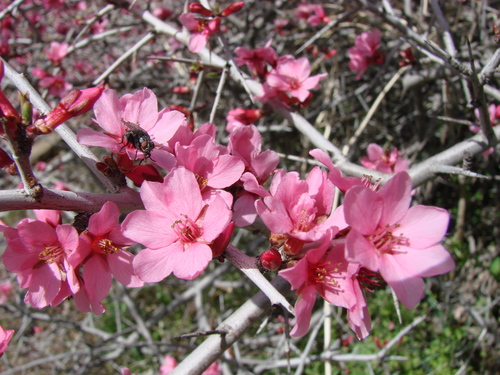
(c) Наталья Бешко, some rights reserved (CC BY-NC), uploaded by Наталья Бешко
What to Eat
Edible parts: Nuts - oil
Oil is extracted from the nuts.
Where to Find It
It is a temperate plant. In Kazakhstan it grows between 400-1,500 m above sea level. It grows on open warm slopes and on bare rocks. It can endure heat, drought and frost when dormant. It can grow in dry climates.
Afghanistan, Asia, Central Asia, Iran, Kazakhstan, Tajikistan, Uzbekistan,
How to Identify
A shrub. It grows 2 m high. The branches are strongly divided. They have long straight thorns. The bark on young branches is shiny red-brown. It later has a rough surface and is whitish-grey. The leaves are small and leathery. They are sword shaped. The flowers are pink and do not have stalks. They appear before the leaves. The fruit is fleshy with a stone inside. The fruit is green but turns pale yellow with a pink or bluish covering. The stone is 1.5-2 cm long and 1-1.5 cm wide.
How to Grow
It is grown from seeds.
Wikipedia
Source ↗Prunus spinosissima, the thorny almond, (Uzbek: bodomcha, lit. 'little almond') is a species of wild almond native to dry areas of Central Asia, Afghanistan, and Iran, preferring to grow at 400-1500 m above sea level. It is morphologically similar to Prunus erioclada, P. lycioides, P. eburnea and P. brahuica.
Other Information
It is cultivated.
Names & Synonyms
Bodomcha
References (4)
- Dzhangaliev, A. D., et al, 2003, The Wild Fruit and Nut Plants of Kazakhstan, Horticultural Reviews, Vol. 29. pp 305-371
- Khojimatov, O. K. et al, 2015, Some wild growing plants in traditional foods of Uzbekistan. Journal of Ethnic Foods. 2 (2015) 25-28 (As Amygdalus spinosissima)
- INFOODSUpdatedFGU-list.xls
- Zeven, A. C. & de West, J. M. J., 1982, Dictionary of cultivated plants and their regions of diversity. Wageningen. p 84 (As Amygdalus spinosissima)
More from Rosaceae


