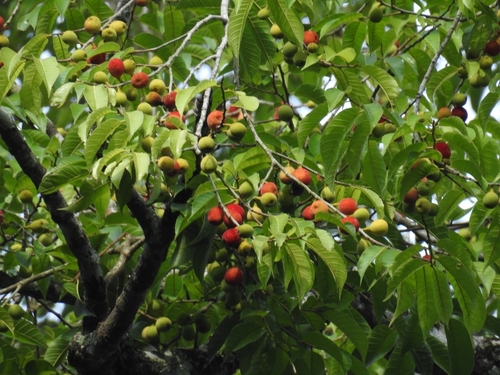
Ficus virens var. sublanceolata
(Miq.) Corner
Kleu chi daw, Big leaved fig

(c) taston, some rights reserved (CC BY-NC)
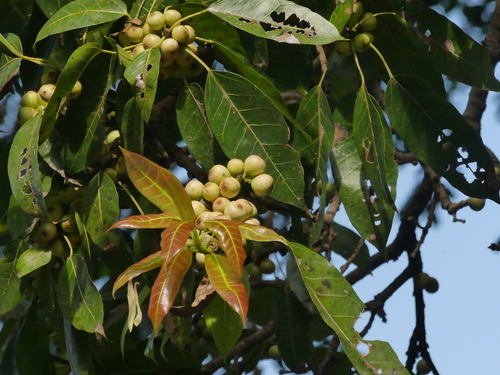
(c) Radha Veach, some rights reserved (CC BY-NC), uploaded by Radha Veach
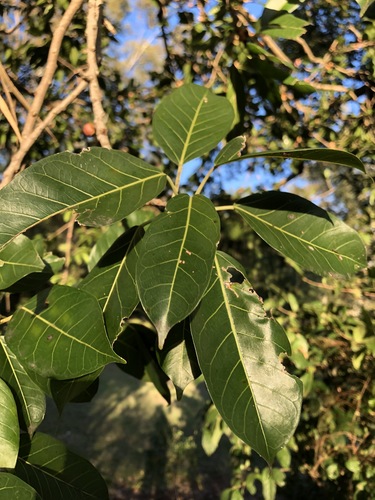
(c) Greg Tasney, some rights reserved (CC BY-SA), uploaded by Greg Tasney
What to Eat
Edible parts: Leaves
The leaves are cooked and eaten as a vegetable, and are commonly sold in local markets as a cultivated food plant.
Where to Find It
It is a tropical plant. In Yunnan.
Asia, Australia, China, Indochina, SE Asia, Sri Lanka, Thailand,
How to Identify
A fig. It is a tree that is a strangler fig. It can be 30 m tall and the trunk 1.8 m wide. It has buttresses at the base. The leaves are alternate and 5-20 cm long by 3-6 cm wide. They are oval to sword shaped and shiny green above and a duller pale green underneath. The figs are white and turn brown with red spots when ripe. They are on the stem. They do not have stalks.
How to Grow
Plants can be grown by seeds or cuttings.
Wikipedia
Source ↗Ficus virens var. sublanceolata is a banyan or strangler fig. It grows alongside the related white fig in the northern part of its range. They differ with narrower leaves, almost lanceolate in shape. Common names in Australia include white fig, sour fig, deciduous fig and banyan. A large example can be seen north of Murwillumbah beside the old Pacific Highway, not far from the state border with Queensland.
Other Information
Leaves are sold in local markets. It is a cultivated food plant.
Names & Synonyms
Kalawalla, Nike, Pahie
References (2)
- Johnson, N., 2002, Environmental Change in northern Thailand: Impact on Wild Edible Plant Availability. Ecology of Food and Nutrition, 41: 5, 373-399 (As Ficus virens var. sublanceolata) Shi, Y. et al, 2014, An ethnobotanical study of the less known wild edible figs (genus Ficus) native to Xishuangbanna Southwest China. Journal of Ethnobiology and Ethnomedicine. 10:68 (As Ficus virens var. sublanceolata)
- Xu, You-Kai, et al, 2004, Wild Vegetable Resources and Market Survey in Xishuangbanna, Southwest China. Economic Botany. 58(4): 647-667. (As Ficus virens var. sublanceolata)