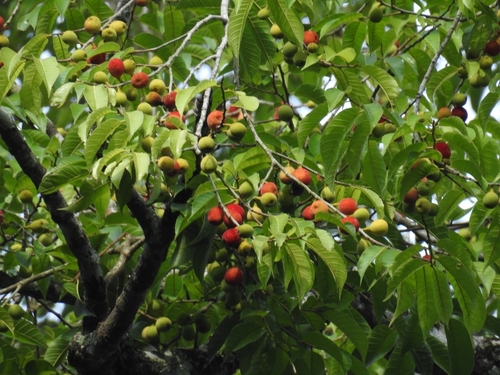
Ficus craterostoma
Warb. ex Mildbr. & Burret
Forest fig

(c) graham_g, some rights reserved (CC BY-NC)
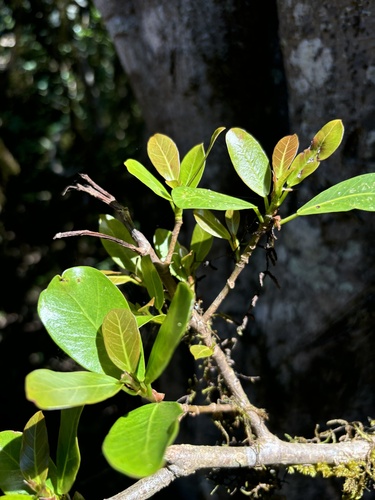
(c) Troos van der Merwe, some rights reserved (CC BY-NC)
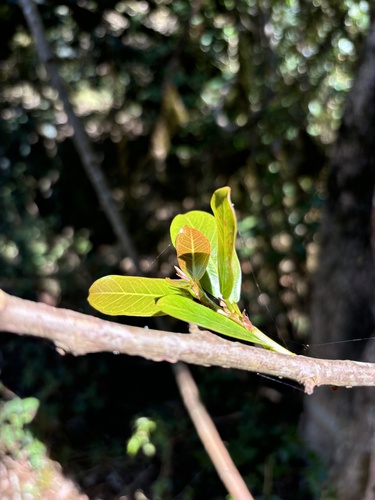
(c) Troos van der Merwe, some rights reserved (CC BY-NC)
What to Eat
Edible parts: Fruit
The figs are eaten as fruit.
Where to Find It
It is a tropical plant. It grows in swamp forests. It grows from sea level to 2,100 m above sea level.
Africa, Angola, Burkina Faso, Central Africa, Congo DR, Congo R, East Africa, Eswatini, Kenya, Mozambique, Sierra Leone, South Africa, Southern Africa, Swaziland, Tanzania, Uganda, West Africa, Zambia, Zimbabwe,
How to Identify
A fig. It is a small tree. It grows 10 m tall. It can be partly attached to other plants. It can grow as a strangler. The leaves are almost opposite or in spirals and 3-9 cm long. They are dark green above and paler underneath. They are almost triangle shaped. The tip is blunt or has 2 lobes. The leaf stalk has a groove along the top. The fruit are figs 15 mm across. They are in pairs in the axils of leaves. They do not have stalks and are warty with red spots.
How to Grow
The wasp pollinators are Alfonsiella michaloudi Wiebes and Alfonsiella pipithiensis.
Wikipedia
Source ↗Ficus craterostoma, a species of strangler fig, is a fig shrub or tree of the Afrotropics that may grow up to 20 m tall. It is found in lowland tropical and swamp forests in the west, or in afromontane forests, including rocky situations, along Africa's eastern escarpments. The western and eastern populations may constitute separate species, as they occur at different altitudes where their ranges meet in central Africa, while they seem to have exclusive pollinating wasp species.
Names & Synonyms
Isihlamfane, Musvasvi, Mutsamvi, Uluzi, Umbombe, Umthombe
References (4)
- Long, C., 2005, Swaziland's Flora - siSwati names and Uses http://www.sntc.org.sz/flora/
- Shava, S., 2000, The Use of Indigenous Plants as Food by a Rural Community in the Eastern Cape: an Educational Exploration. Masters Thesis Rhodes University. p 65
- www.figweb.org
- www.zimbabweflora.co.zw 2011