Ficus petersii
Warb.
Peter's fig

(c) Troos van der Merwe, some rights reserved (CC BY-NC), uploaded by Troos van der Merwe

(c) Troos van der Merwe, some rights reserved (CC BY-NC)
What to Eat
Edible parts: Fruit, Leaves
The fruit is eaten as a snack and used to make an alcoholic drink. The leaves are also edible.
Known Hazards
Where to Find It
It is a tropical plant. It grows in woodland and bushland. It grows on rocky places and termite mounds. It grows up to 1,400 m above sea level.
Africa, Angola, Botswana, Central Africa, East Africa, Eswatini, Kenya, Malawi, Mozambique, Namibia, South Africa, Southern Africa, Swaziland, Tanzania, Zambia, Zimbabwe,
How to Identify
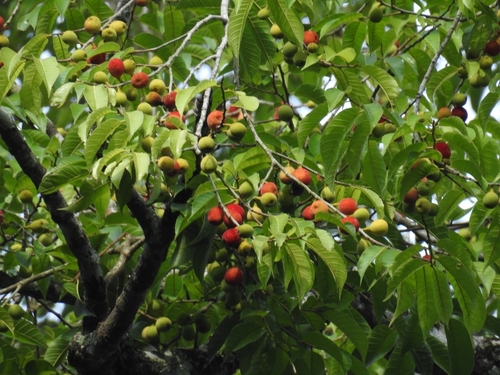
A fig. It is a tree. It grows 20 m high. Young branches are hairy. The leaves are broadly sword shaped and taper to the base. They have a short tip. They are 2-8 cm long and 2-4 cm wide. There are 6-8 veins on each side that form a loop near the edge. The figs usually occur as two together in the axils of leaves. They are oval and 10 cm long by 9 cm wide. They are a reddish colour when ripe.
Nutrition Score: 20/100
| Part | Moisture | kJ | kcal | Protein | Vit A | Vit C | Iron | Zinc |
|---|---|---|---|---|---|---|---|---|
| Fruit | 81.6 | — | — | 5.4 | — | — | — | — |
How to Grow
The wasp pollinator is Alfonsiella binghami.
Production
A fruit weighs about 5 g.
Names & Synonyms
Umbombe, Umtfombe
References (5)
- Long, C., 2005, Swaziland's Flora - siSwati names and Uses http://www.sntc.org.sz/flora/
- Ruiters-Welcome, A. K., 2019, Food plants of southern Africa. Ph.D. thesis. Univ. of Johannesburg p 79
- Welcome, A. K. & Van Wyk, B.-E., 2019, An inventory and analysis of the food plants of southern Africa. South African Journal of Botany 122 (2019) 136–179
- Wilson, A. L. & Downs, C. T., 2012, Fruit nutritional composition and non-nutritive traits of indigenous South African tree species. South African Journal of Botany. 78:30-36
- www.figweb.org