Asclepias fallax
(Schltr.) Schltr.
Milk weed

(c) juddkirkel, some rights reserved (CC BY-NC)
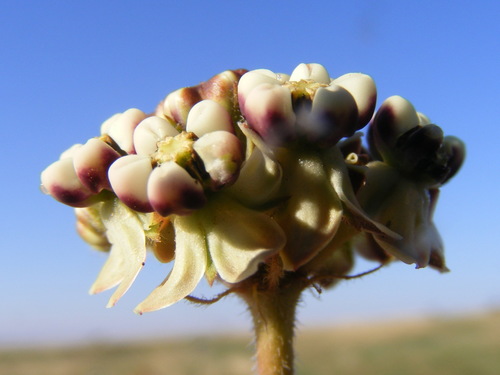
no rights reserved, uploaded by Andrew Deacon
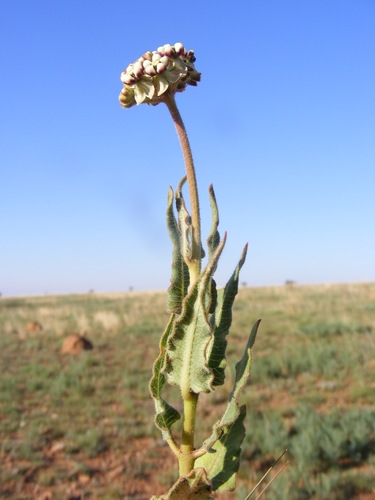
no rights reserved, uploaded by Andrew Deacon
What to Eat
Edible parts: Leaves
The leaves are cooked thoroughly before eating and can be used as a bitter relish.
Where to Find It
It is a subtropical plant.
Africa, Eswatini, South Africa, Southern Africa, Swaziland,
How to Identify
A herb. It grows 40 cm tall. It keeps growing from year to year. The stems are erect and hairy. They have milky sap. The leaves are simple and opposite. They are broadly sword shaped and hairy on both surfaces. The flowers are in a single cluster at the top of the plant. There are 12-15 flowers in a cluster with equal length stalks from one point. The flowers are small and 5 mm long. They are white tinged with purple. The fruit is a single long follicle tapering to the tip. There are 6 or more spine like processes. The seeds are oblong and brown.
Notes
Also put in the family Asclepidaceae.
Names & Synonyms
Umdayi, Umdoyi, Umdzayi, Xihaja
References (5)
- Fox, F. W. & Young, M. E. N., 1982, Food from the Veld. Delta Books. p 104
- Long, C., 2005, Swaziland's Flora - siSwati names and Uses http://www.sntc.org.sz/flora/
- Plowes, N. J. & Taylor, F. W., 1997, The Processing of Indigenous Fruits and other Wildfoods of Southern Africa. in Smartt, L. & Haq. (Eds) Domestication, Production and Utilization of New Crops. ICUC p 185
- Ruiters-Welcome, A. K., 2019, Food plants of southern Africa. Ph.D. thesis. Univ. of Johannesburg p 20
- Welcome, A. K. & Van Wyk, B.-E., 2019, An inventory and analysis of the food plants of southern Africa. South African Journal of Botany 122 (2019) 136–179


