Asparagus plumosus
Baker
Wild asparagus, Asparagus fern

iNaturalist · cc0
no rights reserved
no rights reserved
iNaturalist · cc0
no rights reserved
no rights reserved
iNaturalist · cc0
no rights reserved
no rights reserved
What to Eat
Edible parts: Shoots
The shoots are eaten.
Known Hazards
Where to Find It
It is a tropical plant. It is best in a rich, well-drained soil. It needs a protected sunny position. It is resistant to frost but damaged by drought.
Africa, Australia, East Africa, Eswatini, Europe, Mozambique, Myanmar, Niue, Pacific, Samoa, SE Asia, Slovenia, Southern Africa, Swaziland, Zambia,
Countries: Andorra, Albania, Angola, Austria, Australia, Bosnia & Herzegovina, Belgium, Burkina Faso, Bulgaria, Burundi, Benin, Brunei, Botswana, Belarus, Congo (DRC), Central African Republic, Congo (Republic), Switzerland, Cote d'Ivoire, Cameroon, Cape Verde, Cyprus, Czechia, Germany, Djibouti, Denmark, Algeria, Estonia, Egypt, Eritrea, Spain, Ethiopia, Finland, Fiji, Micronesia, France, Gabon, United Kingdom, Ghana, Gambia, Guinea, Equatorial Guinea, Greece, Guinea-Bissau, Croatia, Hungary, Indonesia, Ireland, Iceland, Italy, Kenya, Cambodia, Kiribati, Comoros, Laos, Liechtenstein, Liberia, Lesotho, Lithuania, Luxembourg, Latvia, Libya, Morocco, Monaco, Moldova, Montenegro, Madagascar, Marshall Islands, North Macedonia, Mali, Myanmar, Mauritania, Malta, Mauritius, Malawi, Malaysia, Mozambique, Namibia, Niger, Nigeria, Netherlands, Norway, Nauru, Niue, New Zealand, Papua New Guinea, Philippines, Poland, Portugal, Palau, Romania, Serbia, Russia, Rwanda, Solomon Islands, Seychelles, Sudan, Sweden, Singapore, Slovenia, Slovakia, Sierra Leone, San Marino, Senegal, Somalia, South Sudan, Sao Tome & Principe, Eswatini, Chad, Togo, Thailand, Timor-Leste, Tunisia, Tonga, Tuvalu, Tanzania, Ukraine, Uganda, Vietnam, Vanuatu, Samoa, South Africa, Zambia, Zimbabwe
How to Identify
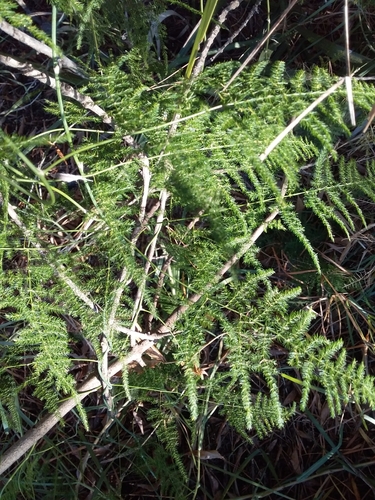
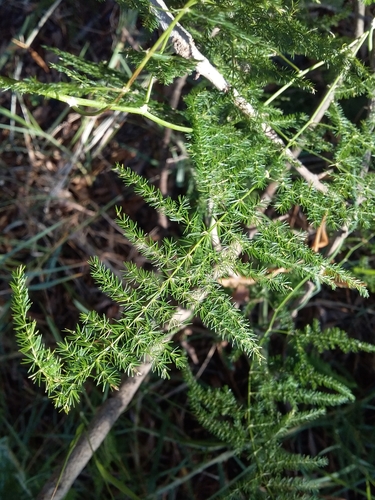
An evergreen vine. It grows 2 m high. The stems are slender and twining. They are green and have prickles. The leaves are dark green and like feathers. The flowers are small and white. The fruit are very small berries.
Names & Synonyms
Akemya-nsyinge, Inhacatze, Kanyut-gale, Kuangulatilo, Puhasti asparagus, Peresasti beluš
Asparagus setaceus (Kunth) Jessop
References (4)
- Bodkin, F., 1991, Encyclopedia Botanica. Cornstalk publishing, p 108
- Fowler, D. G., 2007, Zambian Plants: Their Vernacular Names and Uses. Kew. p 65
- Long, C., 2005, Swaziland's Flora - siSwati names and Uses http://www.sntc.org.sz/flora/
- Parham, B. E. V., 1972, Plants of Samoa. New Zealand Department of Scientific and Industrial Research. Information Series. No. 85 p 58