Brachystelma coddii
R. A. Dyer
ApocynaceaeRoots

iNaturalist · cc-by-nc
(c) Kate Braun, some rights reserved (CC BY-NC), uploaded by Kate Braun
(c) Kate Braun, some rights reserved (CC BY-NC), uploaded by Kate Braun

iNaturalist · cc-by-nc
(c) Kate Braun, some rights reserved (CC BY-NC), uploaded by Kate Braun
(c) Kate Braun, some rights reserved (CC BY-NC), uploaded by Kate Braun
iNaturalist · cc-by-nc
(c) Simon Attwood, some rights reserved (CC BY-NC), uploaded by Simon Attwood
(c) Simon Attwood, some rights reserved (CC BY-NC), uploaded by Simon Attwood
What to Eat
Edible parts: Tubers, Root
The tubers and roots are edible and traditionally used as a famine food.
Where to Find It
It is a subtropical plant. It grows on sandy outcrops.
Africa, Eswatini, South Africa, Southern Africa, Swaziland,
Countries: Angola, Burkina Faso, Burundi, Benin, Botswana, Congo (DRC), Central African Republic, Congo (Republic), Cote d'Ivoire, Cameroon, Cape Verde, Djibouti, Algeria, Egypt, Eritrea, Ethiopia, Gabon, Ghana, Gambia, Guinea, Equatorial Guinea, Guinea-Bissau, Kenya, Comoros, Liberia, Lesotho, Libya, Morocco, Madagascar, Mali, Mauritania, Mauritius, Malawi, Mozambique, Namibia, Niger, Nigeria, Rwanda, Seychelles, Sudan, Sierra Leone, Senegal, Somalia, South Sudan, Sao Tome & Principe, Eswatini, Chad, Togo, Tunisia, Tanzania, Uganda, South Africa, Zambia, Zimbabwe
How to Identify
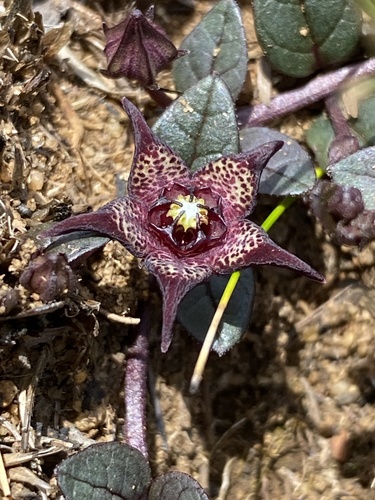
A herb. It keeps growing from year to year. It has a tuber 2-5 cm across. There can be one or several stems. They are 5-15 cm long or longer. The leaves are broadly oval. They have a few hairs. They are dark green and opposite. The flowers usually occur singly. They are star shaped. They have a shallow tube 7 mm across. They are cream with maroon spots.
How to Grow
It can be grown from tubers or bulbs. It can also be grown from seeds. Fresh seed should be used.
Other Information
It is a famine food.
References (1)
- Long, C., 2005, Swaziland's Flora - siSwati names and Uses http://www.sntc.org.sz/flora/


