Senna sophera
(Linn.) Roxb.
Kasondi senna, Pepper leaved senna

(c) Erik, some rights reserved (CC BY-NC), uploaded by Erik
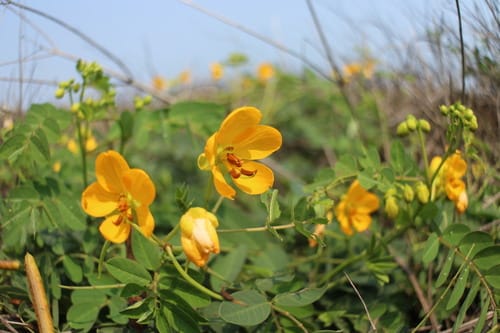
(c) 羅元甫, some rights reserved (CC BY-NC)
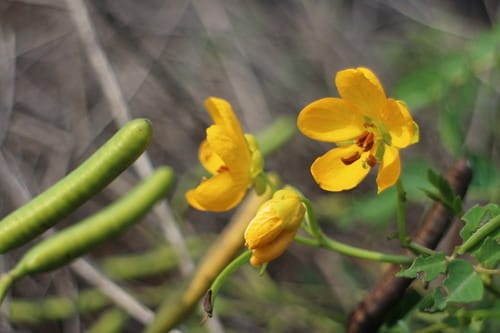
(c) 羅元甫, some rights reserved (CC BY-NC)
What to Eat
Edible parts: Seeds - drink, Leaves, Caution, Vegetable
The leaves are cooked as a vegetable after boiling to remove unpleasant smell and flavour. The seeds are also consumed as a drink.
Known Hazards
Where to Find It
It is a tropical plant. In the Himalayas it grows up to 1,200 m above sea level.
Africa, American Samoa, Andaman Is., Antilles, Aruba, Asia, Bahamas, Bangladesh, Belize, Benin, Brazil, Cambodia, China, Colombia, Congo DR, Cuba, Dominican Republic, Ethiopia, Fiji, Ghana, Guyana, Haiti, Himalayas, Honduras, India, Indochina, Indonesia, Iraq, Ivory Coast, Jamaica, Kenya, Laos, Leeward Is., Liberia, Madagascar, Maldives, Marianas, Mauritius, Myanmar, Nepal, New Caledonia, Nigeria, Northeastern India, Oman, Pakistan, Panama, Papua New Guinea, PNG, Philippines, Puerto Rico, Reunion, Samoa, Saudi Arabia, SE Asia, Seychelles, Sierra Leone, Socotra, Somalia, South America, Tanzania, Thailand, Togo, Tonga, Trinidad-Tobago, Venezuela, Vietnam, West Africa, West Indies, Yemen,
How to Identify
A small annual shrub. It grows about 2 m high. The larger leaves are 7-18 cm long. The leaves are compound with 8-12 pairs of leaflets. The leaflets can be 7 cm long by 2 cm wide. The leaflets taper. The flowers are yellow. They are in groups of 4-10 flowers. The pod is erect and cylinder shaped. It is 6-10 cm long by 1 cm wide.
Nutrition Score: 55/100
| Part | Moisture | kJ | kcal | Protein | Vit A | Vit C | Iron | Zinc |
|---|---|---|---|---|---|---|---|---|
| Leaves | 67.4 | 456 | 109 | 8.5 | — | — | 10.7 | 1.1 |
How to Grow
Prefers a deep, well-drained, moderately fertile sandy loam and a position in full sun. The plant is sometimes a weed. A host of bean common mosaic necrosis virus (BCMNV), Javanese root knot nematode (Meloidogyne javanica) and bean flower thrips (Megalurothrips sjostedti). There are conflicting reports on whether or not this tree has a symbiotic relationship with certain soil bacteria, so it is unclear as to whether this tree fixes atmospheric nitrogen.
Propagation: Seed - pre-soaking for 12 hours in warm water, or abrading the seed with sand can improve germination rates and reduce germination time.
Medicinal Uses
The bark has been used in medicine.
Other Uses
The dried leaves have been shown to have insect repellent and insecticidal properties and when placed amongst stored grain and pulses give some control of storage pests, especially of the cowpea weevil (Callosobruchus maculatus) and the lesser grain weevil (Sitophilus oryzae). Planting Senna sophera in guard rows in vegetable crops has been shown to reduce the damage caused by the giant African land snail (Achatina fulica).
Wikipedia
Source ↗Senna sophera is a shrub or tree in the bean family Fabaceae. It is now widespread in tropical and subtropical regions of the world, but is believed to be native to tropical America. Originally described by Carl Linnaeus in 1753 as Cassia sophera, it has acquired a large number of synonyms. Vernacular names include algarrobilla, baner, kasunda, kasaundi (Hindi) and kolkasunda (Bengali)..
Notes
The bark has been used in medicine. Also as Caesalpinaceae.
Names & Synonyms
Algarrobilla, Baner, Boavaththiyara, Chakara, Chekenda, Chenngi, Dangywe, Kalkasunda, Kasaunda, Kasaundi, Kashawada, Kasunda, Kazaw-pok-nge, Muong ngot, Phak let ket, Pydee tanghadu
References (15)
- Achigan-Dako, E, et al (Eds), 2009, Catalogue of Traditional Vegetables in Benin. International Foundation for Science.
- Bandyopadhyay, S. et al, 2009, Wild edible plants of Koch Bihar district, West Bengal. Natural Products Radiance 8(1) 64-72
- Bandyopadhyay, S., et al, 2012, A Census of Wild Edible Plants from Howrah District, West Bengal, India. Proceedings of UGC sponsored National Seminar 2012 (As Cassia sophera)
- Burkill, H. M., 1985, The useful plants of west tropical Africa, Vol. 3. Kew. (As Cassia sophera)
- Chowdhury, M. & Mukherjee, R., 2012, Wild Edible Plants Consumed by Local Communities of Maldah of West Bengal, India. Indian J.Sci.Res.3(2) : 163-170 (As Cassia sophera)
- Cruz-Garcia, G. S., & Price, L. L., 2011, Ethnobotanical investigation of 'wild' food plants used by rice farmers in Kalasin, Northeast Thailand. Journal of Ethnobiology and Ethnomedicine 7:33
- Grubben, G. J. H. and Denton, O. A. (eds), 2004, Plant Resources of Tropical Africa 2. Vegetables. PROTA, Wageningen, Netherlands. p 564
- Kachenchart, B., et al, 2008, Phenology of Edible Plants at Sakaerat Forest. In Proceedings of the FORTROP II: Tropical Forestry Change in a Changing World. Bangkok, Thailand.
- Kew Plants of the World Online
- Kumar, R. & Saikia, P., 2020, Wild edible plants of Jharkhand and their utilitarian perspectives. Indian Journal of Traditional Knowledge Vol 19 (2), April 2020, pp 237-250
- Kumar, S. A., Manus, D. & Mallika, M., 2018, Impact of non-timber forest products on Forest and in Livelihood Economy of the People of Adjoining Areas of Jalpaiguri Forest Division, West Bengal, India. Int. J. of Life Sciences, 2018; 6 (2):365-385
- Roa, J. A. G. & Boada, D. S. G., 2018, Fundación para el Fortalecimiento de la Fruticultura y Plantas Alimenticias no Convencionales en Colombia.
- Sujanapal, P., & Sankaran, K. V., 2016, Common Plants of Maldives. FAO & Kerala FRI, p 238
- Wild edible plants of Himachal Pradesh (As Cassia sophera)
- World Checklist of Useful Plant Species 2020. Royal Botanic Gardens, Kew




