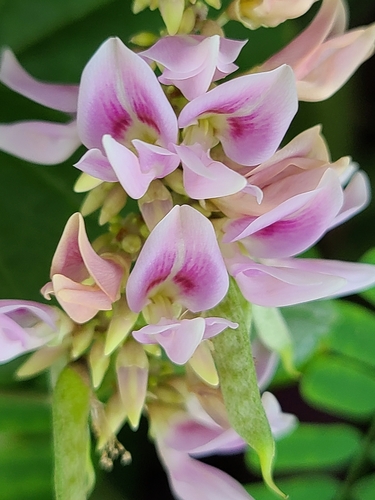
Senna spectabilis
(DC.) Irwin & Barneby
Yellow cassia

(c) Neptalí Ramírez Marcial, some rights reserved (CC BY)

(c) Neptalí Ramírez Marcial, some rights reserved (CC BY)

(c) Jose Giovani, some rights reserved (CC BY-NC)
What to Eat
Edible parts: Fruit pulp
The fruit pulp is edible.
Where to Find It
It is a tropical plant. It grows in mixed forests up to 2,000 m above sea level. In Argentina it grows from sea level to 1,000 m above sea level. In XTBG Yunnan (As Cassia)
Africa, Angola, Argentina, Asia, Australia, Belize, Benin, Bolivia, Brazil, Burundi, Cameroon, Caribbean, Central Africa, Central African Republic, CAR, Central America, Chad, China, Colombia, Comoros, Congo DR, Congo R, Costa Rica, Cuba, Dominican Republic, East Africa, Ecuador, El Salvador, Gabon, Gambia, Guatemala, Haiti, Hawaii, Himalayas, Honduras, India, Indochina, Indonesia, Kenya, Leeward Is., Malawi, Malaysia, Marquesas, Mexico, Myanmar, Nicaragua, Nigeria, Pacific, Panama, Papua New Guinea, PNG, Paraguay, Peru, Puerto Rico, Rwanda, Sao Tome and Principe, SE Asia, Senegal, Singapore, South America*, Sri Lanka, Tanzania, Thailand, Tonga, Trinidad-Tobago, Uganda, Venezuela, West Africa, West Indies, Zambia, Zimbabwe,
How to Identify
A shrub or small tree. It grows 7 m high. The leaves have 6-15 pairs of leaflets. These are 3-7 cm long by 1-2 m wide. They are oval with pointed tip. They have fine hairs underneath. The flowers are yellow. They are in large unbranched clusters at the ends of twigs. The fruit are pods 18-25 cn long by 1 cm wide. They are black and glossy.
How to Grow
Plants can be grown from seeds. Boiling water is poured over the seeds and then they are allowed to soak to 24 hours. Plants can be grown from cuttings.
Propagation: Seed - it has a hard seedcoat and may benefit from scarification before sowing to speed up germination. This can usually be done by pouring a small amount of nearly boiling water on the seeds (being careful not to cook them!) and then soaking them for 12 - 24 hours in warm water. By this time they should have imbibed moisture and swollen - if they have not, then carefully make a nick in the seedcoat (being careful not to damage the embryo) and soak for a further 12 hours before sowing. Sow the seed in a partially shaded position in a nursery seedbed. A germination rate of less than 30% can be expected from untreated seed, with the seed sprouting within 10 - 30 days. When the seedlings are 4 - 6cm tall, pot them up into individual containers and they should be ready to plant out 4 - 5 months later.
Medicinal Uses
Senna spectabilis has a few medicinal properties. The plant can be used as a treatment for ringworm and skin diseases. After extracting a leaf on alcohol there was significant antifungal activity, which suggests it can be used with infections caused by Candida albicans. The plant is effective against food borne pathogen B. Senna spectabilis also produces several substances that we deem necessary for metabolism, in which they are also used as a medicine or pharmaceutical drug. Pharmaceuticals that can produce piperidine alkaloids, pentacyclic terpenoids, and anthraquinones. It is also used in both eastern and western traditional medicine treating several different diseases and symptoms. Senna spectabilis is also used as a medicinal plant in Cameroon by traditional healers to treat epilepsy, constipation, insomnia, and anxiety. In a recent study, the anticonvulsant effects of S. spectabilis was observed on mice undergoing seizures induced by maximal electroshock (MES), pentylenetetrazole (PTZ) and pilocarpine (PC). It was discovered that the mice undergoing PTZ induced seizures were protected 100% of the time when administered the lowest plant dose. In another experiment on differing doses, the plant offered protection up to 75% of the time on antagonized seizures induced by PC. The study concluded that Senna spectabilis contains anticonvulsant activity, most likely acting on the GABA complex receptor. Other non medical related uses, S. spectabilis is used in agroforestry as a shade tree. The species is useful for fodder, mulch, firewood and as a source of honey. The heartwood is brown and the sapwood is white-ish. The wood is heavy, soft, and hard, when kept dry can be resistant to termites. For this reason S. spectabilis is often used for economic reasons. The wood is used for tool handles, boxes, furniture, lumber and other construction materials. The wood is also used as fuel wood and to make charcoal. S. spectabilis was introduced to Africa as an ornamental and a boundary marker. It is not highly valued but it produces good quality firewood. Senna spectabilis can invade disturbed forests, forest edges, and gaps where it can establish and suppress the regeneration of native species. Recently, Tamil Nadu started making paper for the press for better utilization of this invasive tree spreading in Mudumalai Tiger Reserve.
Other Uses
The heartwood is brown; the sapwood is whitish. The wood is moderately heavy, soft to hard, slightly compact, moderately durable if kept dry and resistant to the attacks of termites. Because of its small dimensions, it is only used for small implements, tool handles, boxes etc. The wood is used for fuel and to make charcoal. The plant can be grown for shade and as a boundary market. Leaves can be used as mulch.
Wikipedia
Source ↗Senna spectabilis is a plant species of the legume family (Fabaceae) in the subfamily Caesalpinioideae native to South and Central America. They are often grown as an ornamental in front yards, parks, gardens, buildings etc. due to their bright yellow flowers that bloom during the summer months. They are also known as golden wonder tree, American cassia, popcorn tree, Cassia excelsa, golden shower tree or Archibald's cassia. The plant has become an invasive alien species in parts of Africa such as Kenya, Malawi, Tanzania and Uganda, and also in South-India, after it was introduced for resources such as firewood as well as to help combat deteriorating ecosystems affected by deforestation and desertification. Currently, S. spectabilis is overtaking native tree species of forestry ecosystems around the world because of its ability to grow quickly.
Notes
Also as Caesalpinaceae.
Names & Synonyms
Pohon kasia amerika, Keshya wa maluwa
References (8)
- Bunderson, W. T. et al, 2002, Common Agroforestry Species in Malawi. Malawi Agroforestry Extension Project, Pubication No. 46, Lilongwe. p 26
- Burkill, H. M., 1985, The useful plants of west tropical Africa, Vol. 3. Kew.
- Gardner, S., et al, 2000, A Field Guide to Forest Trees of Northern Thailand, Kobfai Publishing Project. p 172
- Kew Plants of the World Online
- Latham, P., 2004, Useful Plants of Bas-Congo province. Salvation Army & DFID p 254
- Sukarya, D. G., (Ed.) 2013, 3,500 Plant Species of the Botanic Gardens of Indonesia. LIPI p 504
- von Katja Rembold, 2011, Conservation status of the vascular plants in East African rain forests. Dissertation Universitat Koblenz-Landau p 182
- World Checklist of Useful Plant Species 2020. Royal Botanic Gardens, Kew