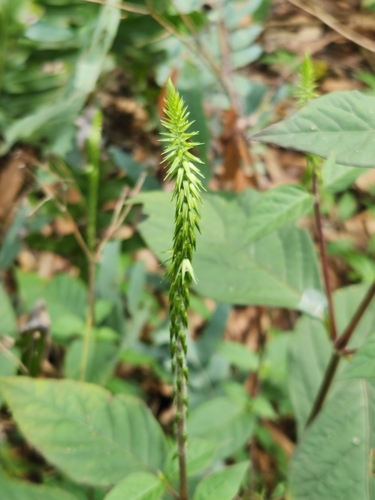
Celosia isertii
C. C. Townsend
Cockscomb

Royal Botanic Gardens, Kew

Ehoarn Bidault

Ehoarn Bidault
What to Eat
Edible parts: Leaves
The leaves are cooked and eaten, and are also used in sauces and for flavouring.
Where to Find It
It is a tropical plant. It grows in secondary forests and near streams and in damp sites. In Zambia it grows between 1,500-1,800 m altitude.
Africa, Angola, Cameroon, Central Africa, Congo, East Africa, Equatorial Guinea, Gabon, Gambia, Nigeria, Senegal, Sierra Leone, Tanzania, Uganda, West Africa, Zambia,
How to Identify
A straggling herb. It can be woody at the base. It grows 3 m tall. The stems and branches are hairy. The leaves are narrowly oval and hairy underneath especially along the veins. Leaves can be 3.5-10 cm long by 2.5-5 cm wide. The flower heads are white and in the axils of the leaves and at the top of the plant. The fruit is a capsule 2-4 mm long. The seeds are black and shiny. They are 1 mm long.
Other Information
It is enjoyed as a vegetable.
Names & Synonyms
Jarfundu, Nanafo
References (4)
- Burkill, H. M., 1985, The useful plants of west tropical Africa, Vol. 1. Kew.
- Flora Zambesiaca. http://apps.kew.org/efloras
- Seidemann J., 2005, World Spice Plants. Economic Usage, Botany, Taxonomy. Springer. p 90
- World Checklist of Useful Plant Species 2020. Royal Botanic Gardens, Kew