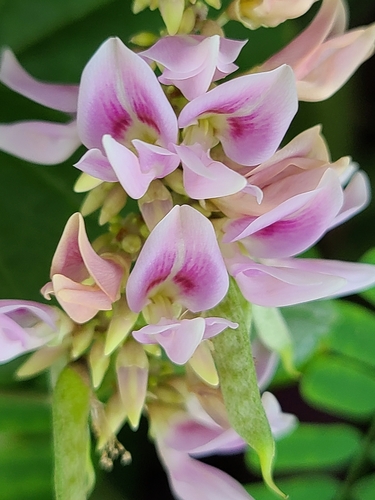
Eriosema youngii
Baker f.

(c) Bart Wursten, some rights reserved (CC BY-NC), uploaded by Bart Wursten

(c) Bart Wursten, some rights reserved (CC BY-NC)
What to Eat
Edible parts: Root ?
The root may be edible (status uncertain).
Where to Find It
It is a tropical plant. It grows in marshy and wooded mountain grassland.
Africa, Angola, Central Africa, East Africa, Guinea, Guinée, Mali, Tanzania, West Africa, Zambia,
How to Identify
A slender stemmed herb. The root produces a swollen tuber about 2.5 cm long and 1.5 cm across. There is a single stem 20 cm long and it has 1 or 2 trailing branches near the base. The leaves have one leaflets that is 2-13 cm long by about 1 cm wide. It is narrowly oval. There are 2-4 flowers in a group in the axils of the leaves. The flower standard is yellow inside and reddish outside. The fruit is a pod 9-10 mm long by 5 mm wide. It has rusty hairs. The seeds are brown with dark speckles. They are 2-3 mm long by 2 mm wide and 1 mm thick.
Names & Synonyms
References (2)
- Burkill, H. M., 1985, The useful plants of west tropical Africa, Vol. 3. Kew.
- World Checklist of Useful Plant Species 2020. Royal Botanic Gardens, Kew