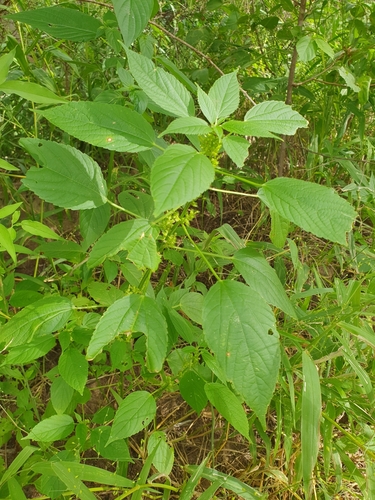
Erythrococca chevalieri
(Beille) Prain

Saint Fédriche NDZAI

Saint Fédriche NDZAI

Saint Fédriche NDZAI
What to Eat
Edible parts: Leaves, Vegetable
The leaves are eaten as a vegetable.
Where to Find It
It is a tropical plant. It grows in forest.
Africa, Cameroon, Central Africa, Congo DR, Congo R, Guinea, Guinée, West Africa,
How to Identify
A tropical shrub in the Euphorbiaceae family that grows in forest habitats. The leaves are eaten as a vegetable.
Medicinal Uses
The leaves are considered aphrodisiac and are taken as a treatment for gonorrhoea. The leaf sap is drunk as a treatment for bronchial complaints. The leaves are applied topically to heal sores and scabies. The leaf sap is applied topically to treat itch and a stiff neck. An infusion of the roots is taken to relieve stomach complaints. Alkaloids have been recorded in the plant: the leaves contain a trace; the bark, 0.1 - 0.3%;the roots, 0.3 - 1.0%.
Names & Synonyms
References (5)
- Burkill, H. M., 1985, The useful plants of west tropical Africa, Vol. 2. Kew.
- Grubben, G. J. H. and Denton, O. A. (eds), 2004, Plant Resources of Tropical Africa 2. Vegetables. PROTA, Wageningen, Netherlands. p 299
- Moutsambote, J., 1996, Vegetation forestiere et plantes alimentaires de la region de la Sangha. Chp. 11 of Bien Manger et Bien Vivre. ORSTOM p 119
- Nkeoua, G. & Boundzanga, G. C., 1999, Donnees sur les produits forestieres non ligneux en Republique du Congo. FAO. p 27
- World Checklist of Useful Plant Species 2020. Royal Botanic Gardens, Kew