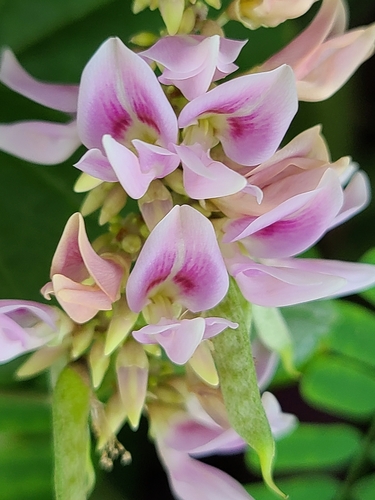
Vigna gracilis
(Guill. & Perr.) Hook. f.
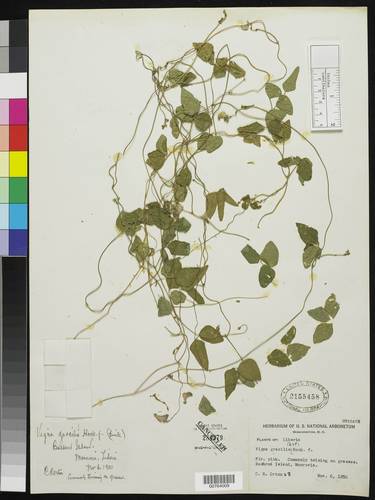
iNaturalist · cc-by-nc-sa
(c) Smithsonian Institution, National Museum of Natural History, Department of Botany, some rights reserved (CC BY-NC-SA)
(c) Smithsonian Institution, National Museum of Natural History, Department of Botany, some rights reserved (CC BY-NC-SA)
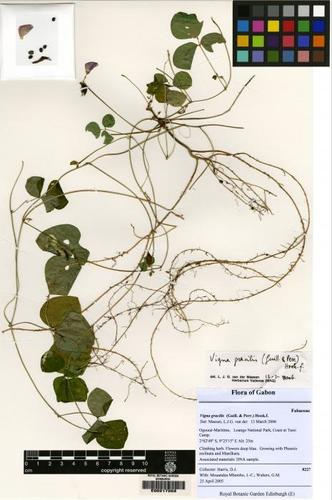
iNaturalist · cc-by-nc
(c) Royal Botanic Garden Edinburgh, some rights reserved (CC BY-NC)
(c) Royal Botanic Garden Edinburgh, some rights reserved (CC BY-NC)

wikimedia · cc0
Wikimedia Commons - NMNH
Wikimedia Commons - NMNH
What to Eat
Edible parts: Pods, Seeds, Vegetable
The pods and seeds are eaten as vegetables.
Where to Find It
It is a tropical plant. It grows in damp grassy places. It is near the edges of forests and near swamps.
Africa, Burkina Faso, Central Africa, Congo, Gabon, Guinea, Guinée, Guinea-Bissau, Niger, Nigeria, Sao Tome and Principe, Senegal, Sierra Leone, West Africa,
Countries: Angola, Burkina Faso, Burundi, Benin, Botswana, Congo (DRC), Central African Republic, Congo (Republic), Cote d'Ivoire, Cameroon, Cape Verde, Djibouti, Algeria, Egypt, Eritrea, Ethiopia, Gabon, Ghana, Gambia, Guinea, Equatorial Guinea, Guinea-Bissau, Kenya, Comoros, Liberia, Lesotho, Libya, Morocco, Madagascar, Mali, Mauritania, Mauritius, Malawi, Mozambique, Namibia, Niger, Nigeria, Rwanda, Seychelles, Sudan, Sierra Leone, Senegal, Somalia, South Sudan, Sao Tome & Principe, Eswatini, Chad, Togo, Tunisia, Tanzania, Uganda, South Africa, Zambia, Zimbabwe
How to Identify
A slender twining herb of the Fabaceae family, growing about 1 m long and found in damp grassy places near forest edges and swamps in tropical regions.
Names & Synonyms
Baielo, Burongoi, Djulundium, Ngakwi
Dolichos gracilis Guill. & Perr.Vigna afzelii BakerVigna multiflora Hook. f.Vigna occidentalis Baker f.
References (4)
- Burkill, H. M., 1985, The useful plants of west tropical Africa, Vol. 3. Kew.
- Dakora, F. D., 2013, Biogeographic Distribution, Nodulation and Nutritional Attributes of Underutilized Indigenous Agrican Legumes. Acta Horticulturae Number 979 Vol. 1. p 53
- Grubben, G. J. H. and Denton, O. A. (eds), 2004, Plant Resources of Tropical Africa 2. Vegetables. PROTA, Wageningen, Netherlands. p 565
- World Checklist of Useful Plant Species 2020. Royal Botanic Gardens, Kew